In a classroom in London, a teacher once told her students, “Learning grammar is like building a house.” A student replied, “So grammar is a house?” The class laughed. The teacher smiled and explained the difference between analogy and metaphor. That small moment showed how easily these two tools can be confused.
The difference between analogy and metaphor matters in writing, teaching, and public speaking. Many learners struggle with the difference between analogy and metaphor because both compare things. Yet the difference between analogy and metaphor lies in purpose and structure. Understanding the difference between analogy and metaphor sharpens thinking and improves expression in everyday communication.
Key Difference Between the Both
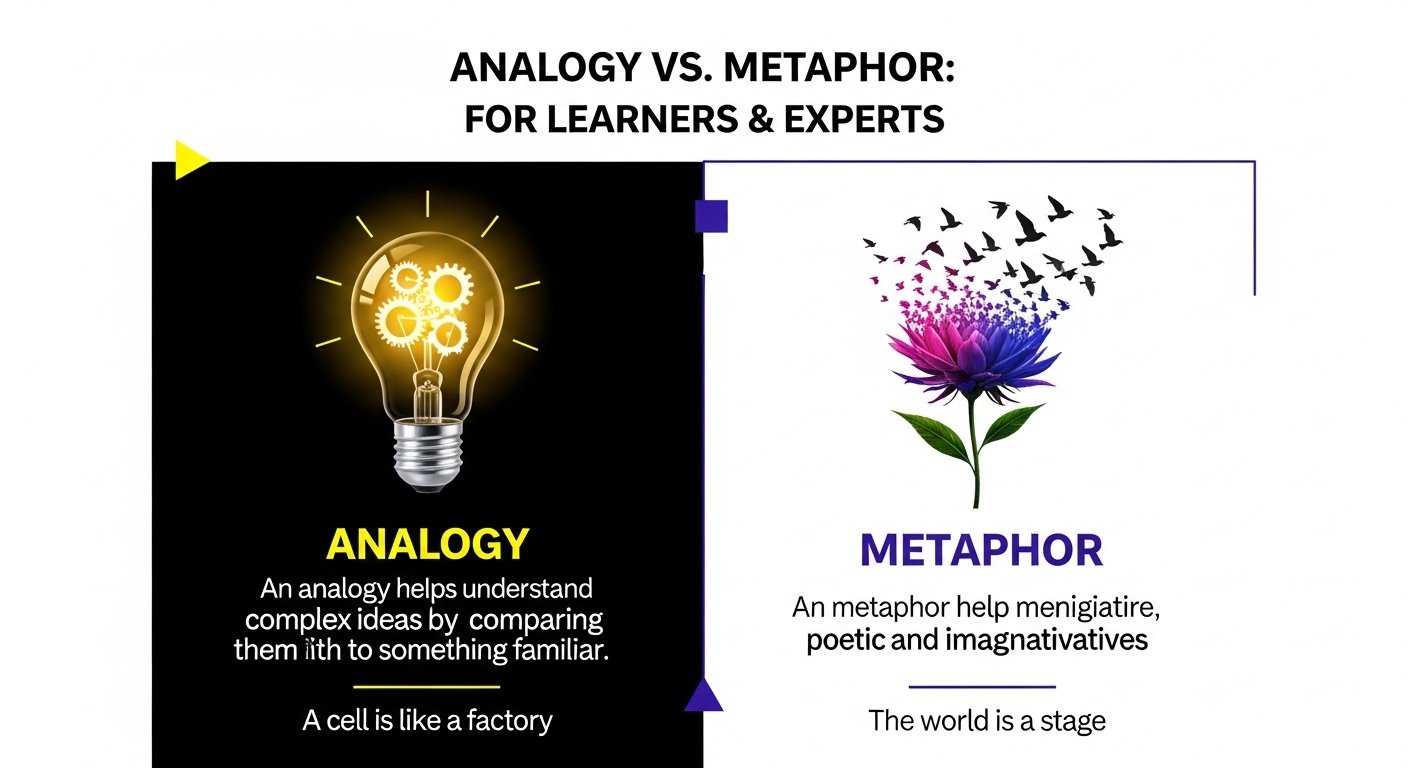
The key difference between analogy and metaphor is this:
- An analogy explains by comparing two things in detail.
- A metaphor describes by saying one thing is another.
An analogy builds a bridge.
A metaphor paints a picture.
Why the Difference Between Analogy and Metaphor Is Necessary to Know
Knowing the difference between analogy and metaphor helps:
- Students write clearer essays.
- Teachers explain complex ideas simply.
- Lawyers build logical arguments.
- Speakers persuade audiences effectively.
- Writers avoid confusion in communication.
In society, clear language prevents misunderstanding. When ideas are precise, learning becomes stronger and discussion becomes smarter.
Pronunciation (US & UK)
Analogy
- US: /əˈnælədʒi/
- UK: /əˈnælədʒi/
Metaphor
- US: /ˈmetəfɔːr/
- UK: /ˈmetəfə/
Now that we understand their sound, let us explore their structure and power.
Difference Between Analogy and Metaphor
1. Purpose
Analogy explains.
Example 1: The heart works like a pump.
Example 2: The brain is like a computer processor.
Metaphor describes.
Example 1: The classroom was a zoo.
Example 2: Time is a thief.
2. Length
Analogy is longer.
Example 1: A teacher compares democracy to a team sport and explains rules.
Example 2: A coach explains life as a marathon with stages.
Metaphor is short.
Example 1: Life is a journey.
Example 2: He has a heart of stone.
3. Structure
Analogy uses “like” or logical comparison.
Example 1: Studying is like planting seeds.
Example 2: Memory works like a library system.
Metaphor directly equates.
Example 1: Knowledge is power.
Example 2: Her voice is music.
4. Function in Writing
Analogy clarifies ideas.
Example 1: Teachers explain atoms using solar system analogy.
Example 2: Doctors compare veins to pipelines.
Metaphor adds emotion.
Example 1: The city is a jungle.
Example 2: His words were daggers.
5. Logical vs Artistic
Analogy is logical.
Example 1: Comparing the government to a machine with parts.
Example 2: Comparing teamwork to gears in a clock.
Metaphor is artistic.
Example 1: The night swallowed the village.
Example 2: Hope is a candle in darkness.
6. Academic Use
Analogy is common in science.
Example 1: Electric current is like water flow.
Example 2: The atom is like a tiny solar system.
Metaphor is common in poetry.
Example 1: The moon is a silver coin.
Example 2: Love is a battlefield.
7. Detail Level
Analogy gives explanation.
Example 1: A car engine compared to human muscles step by step.
Example 2: Internet compared to highways with data traffic.
Metaphor gives image only.
Example 1: The world is a stage.
Example 2: Books are windows.
8. Tone
Analogy is informative.
Example 1: A teacher calmly explains evolution with analogy.
Example 2: A lawyer uses analogy in court.
Metaphor is expressive.
Example 1: The news hit like thunder.
Example 2: Fear is a shadow.
9. Audience
Analogy suits learners.
Example 1: Explaining math using pizza slices.
Example 2: Explaining coding like solving puzzles.
Metaphor suits creative readers.
Example 1: The sun smiled.
Example 2: Anger is fire.
10. Goal
Analogy aims to teach.
Example 1: Explaining DNA like a recipe book.
Example 2: Comparing business growth to tree growth.
Metaphor aims to impress or move.
Example 1: He drowned in sorrow.
Example 2: She is a shining star.
Nature and Behaviour
Analogy behaves like a teacher. It explains carefully. It walks step by step.
Metaphor behaves like an artist. It creates quick images. It sparks emotion instantly.
Why People Are Confused
- Both compare two things.
- Both improve understanding.
- Both appear in writing classes.
- Both are figures of speech.
Their shared purpose causes confusion.
Table: Difference and Similarity
| Feature | Analogy | Metaphor | Similarity |
|---|---|---|---|
| Purpose | Explains | Describes | Both compare |
| Length | Long | Short | Both creative tools |
| Tone | Logical | Emotional | Used in writing |
| Field | Science, teaching | Poetry, literature | Improve clarity |
| Structure | Uses comparison words | Direct statement | Figurative language |
Which Is Better in What Situation?
Analogy is better in education and technical writing. It helps students understand difficult ideas. Scientists and teachers prefer analogy when they want clarity. It reduces confusion and builds logical understanding.
Metaphor is better in speeches and poetry. It touches emotions quickly. Writers and speakers use metaphor to inspire, persuade, or create vivid imagery. It adds beauty to language.
Use in Metaphors and SimilesInterestingly, metaphor itself appears inside similes and analogies.
Example of metaphor about analogy:
“An analogy is a bridge of logic.”
Example of metaphor about metaphor:
“A metaphor is a spark in language.”
Connotative Meaning
Analogy
Positive: clarity, intelligence
Neutral: comparison tool
Example: His analogy made science simple.
Metaphor
Positive: creativity, beauty
Neutral: figure of speech
Example: Her metaphors filled the poem with color.
Idioms or Proverbs
There are no direct idioms using “analogy” or “metaphor,” but related expressions exist:
- “Paint a picture.”
Example: The speaker painted a picture with metaphor. - “Draw a parallel.”
Example: The teacher drew a parallel using analogy.
Works in Literature
Metaphors We Live By (Non-fiction, George Lakoff and Mark Johnson, 1980)
- A Handbook to Literature (Reference, William Harmon, 1986)
Movies
- Dead Poets Society (1989, USA)
- Freedom Writers (2007, USA)
- Learn more…
FAQs
1. Is an analogy the same as a metaphor?
No. An analogy explains. A metaphor describes.
2. Can a metaphor be part of an analogy?
Yes. An analogy may include metaphors.
3. Which is more detailed?
An analogy is more detailed.
4. Which is more emotional?
A metaphor is more emotional.
5. Are both figures of speech?
Yes. Both belong to figurative language.
How Both Are Useful for Surroundings
Analogy helps in classrooms and debates.
Metaphor enriches literature and media.
Both improve communication in society.Final Words for Both
Analogy builds understanding.
Metaphor builds imagination.
Conclusion
The difference between analogy and metaphor may appear small, but its impact is powerful. An analogy explains ideas through logical comparison, while a metaphor creates meaning through direct imagery. Both are essential tools in language. Teachers use analogy to clarify. Poets use metaphor to beautify. Understanding the difference between analogy and metaphor strengthens writing, speaking, and thinking skills. When used wisely, these tools turn simple language into effective communication. Mastering them means mastering expression itself.

The author is a Ph.D scholar and has keen interest in what is happening around the world. I love to write, travel and observe. Constant zeal for new ideas is a trigger for me. Love, respect and live peacefully
2 thoughts on “Difference Between Analogy and Metaphor:For Learners & Experts”