

Difference between internship and externship and difference between internship and externship is a common topic for students and early-career professionals seeking practical experience. Although both opportunities provide valuable exposure to real-world work environments, they differ significantly in duration, depth, and level of involvement.
To begin with, understanding the difference between internship and externship helps individuals choose the right path based on their career goals. Internships are typically longer and involve hands-on work, allowing participants to actively contribute to projects. In contrast, externships are usually shorter and focus more on observation and learning from professionals. Therefore, recognizing the difference between internship and externship is essential for making informed decisions and maximizing career development opportunities.


One offers immersion. The other offers exploration. Both can change your trajectory—but only if you understand which runway you’re actually stepping onto.
In the competitive landscape of modern career building, experiential learning isn’t optional—it’s essential. Yet two of the most powerful professional development opportunities remain shrouded in confusion. Internship and externship sound similar, look similar on resumes, and both promise “real-world experience.” But beneath the surface, they represent fundamentally different investments of time, energy, and strategic positioning.
Choose wrong, and you might spend months making coffee when you needed portfolio projects. Choose right, and you transform from student to professional before graduation. This comprehensive guide dismantles every distinction, reveals hidden advantages, and provides the decision framework that turns experiential learning from gamble into strategy.
The Foundation: Defining the Landscape
Before dissecting differences, we must understand what unites these opportunities. Both internships and externships are structured experiential learning programs designed to bridge academic theory and professional practice . They help to build resumes, expand networks, and provide career clarity. Both signal to future employers that you’ve moved beyond classroom simulations into actual professional environments.
However, their execution, duration, compensation, and strategic value diverge dramatically. Understanding these distinctions isn’t academic pedantry—it’s career-critical decision-making.
What Is an Internship? The Immersion Experience
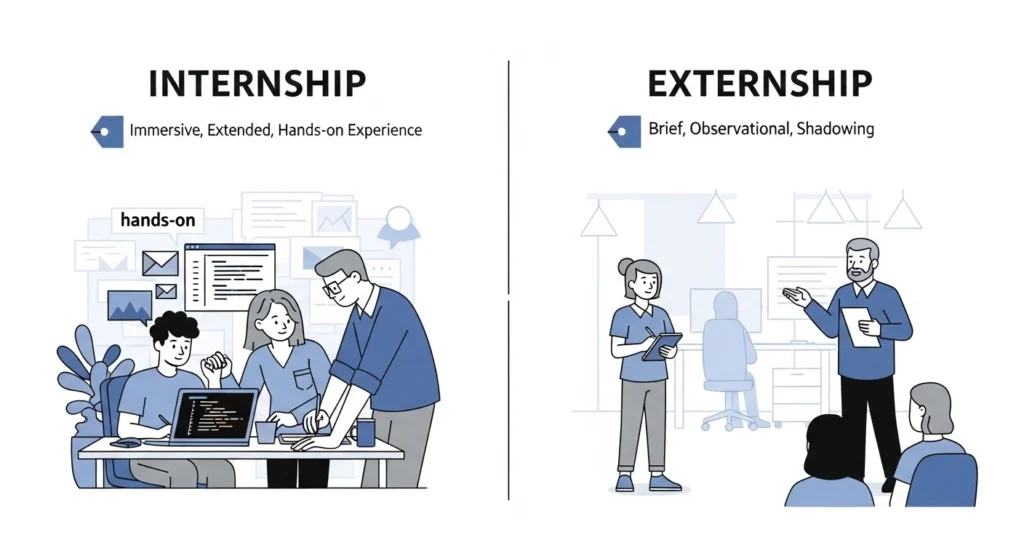
An internship is an extended professional placement where you actively contribute to organizational objectives, functioning as a temporary team member with defined responsibilities and deliverables . It’s the closest most students get to an entry-level position while still maintaining academic status.
Core Characteristics of Internships
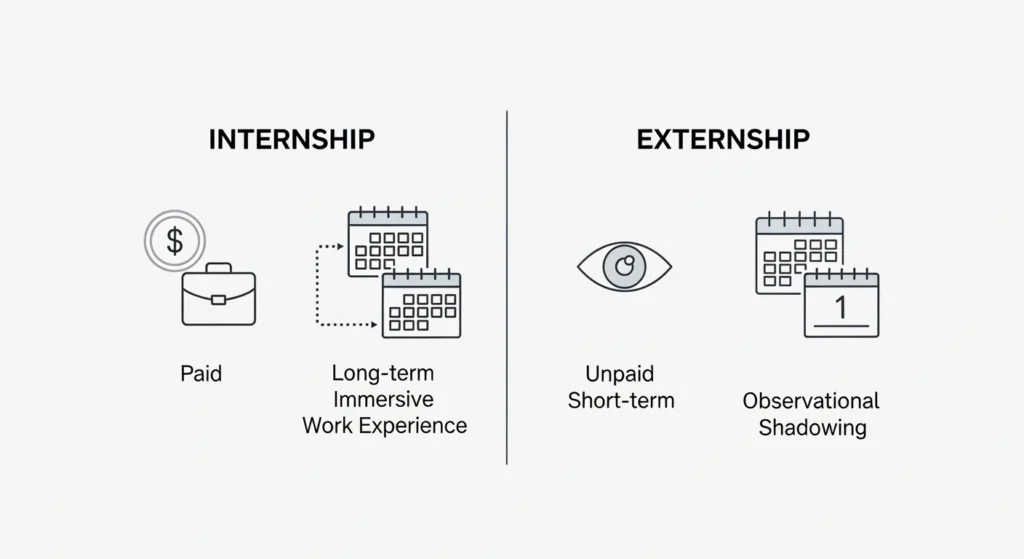
Duration: Typically 8-12 weeks minimum, often extending to several months or even a full year . Summer internships align with academic breaks; semester internships accommodate part-time schedules alongside coursework.
Compensation: Approximately 60% of internships offer payment—hourly wages, stipends, or salaries . Paid internships significantly outnumber paid externships, though unpaid opportunities persist in competitive industries.
Academic Integration: Frequently eligible for college credit, particularly when formally integrated into degree requirements . Requires documentation, faculty oversight, and alignment with curricular objectives.
Responsibilities: Project-based tasks, clerical duties, collaborative work with staff, participation in meetings, and direct contribution to organizational outcomes . Interns execute; they don’t merely observe.
Employment Pipeline: About 70% of interns receive job offers from their host organizations . The internship functions as an extended interview, allowing employers to evaluate fit before extending permanent offers.
The Strategic Value of Internships
Internships provide depth over breadth. They transform theoretical knowledge into applied capability, building the muscle memory of professional execution. When you complete an internship, you don’t just understand a field—you’ve demonstrated competence within it.
According to the National Association of Colleges and Employers, paid interns receive an average of 1.12 job offers per student, compared to 0.64 for graduates with no internship experience . The data is unambiguous: internships convert academic investment into employment outcomes.
What Is an Externship? The Exploration Experience
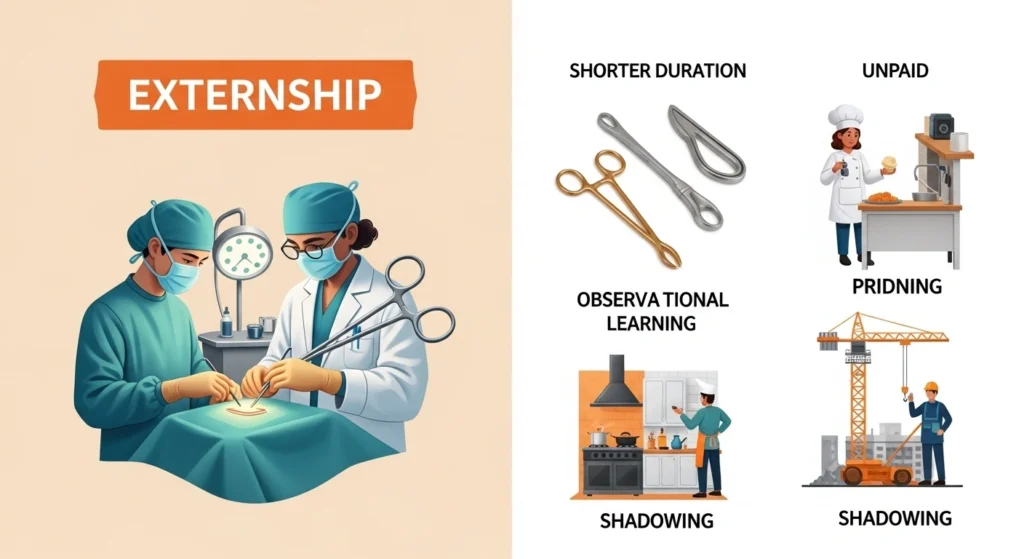

An externship is a condensed, observation-focused professional experience where you shadow experienced practitioners to understand daily responsibilities, workplace culture, and career trajectories without assuming independent work duties . Think of it as an extended informational interview with backstage access.
Core Characteristics of Externships
Duration: Brief and flexible—anywhere from a single day to eight weeks . Many students complete externships during winter break, spring break, or intersession periods when longer commitments are impossible.
Compensation: Generally unpaid, though some professional fields (particularly healthcare and production) offer stipends or course credit in lieu of payment . The primary currency is exposure, not income.
Academic Integration: Rarely eligible for formal academic credit due to short duration and observational nature . Functions more as career exploration than curricular fulfillment.
Responsibilities: Shadowing professionals, attending meetings, conducting informational interviews, reviewing company literature, touring facilities, and observing workflows . Externs witness; they rarely execute.
Employment Pipeline: Less direct than internships, but valuable for network building and career clarification. Multiple externships can accelerate pathfinding for undecided students .
The Strategic Value of Externships
Externships provide breadth over depth. They function as career reconnaissance, allowing you to sample professional environments before committing to intensive immersion. For students debating majors, considering career pivots, or evaluating graduate school, externships offer low-risk intelligence gathering.
As Milly Barker, tech entrepreneur and founder of RemotePad, notes: “Externships are for exploration, and getting a taste of a career without the pressure. Internships are for immersion, gaining significant experience, and possibly securing a job in the field” .
The Critical Distinctions: A Comparative Analysis
| Dimension | Internship | Externship | Strategic Implication |
|---|---|---|---|
| Duration | 8 weeks to 12+ months | 1 day to 8 weeks | Internships require significant time investment; externships accommodate busy schedules |
| Compensation | ~60% paid | Generally unpaid | Internships offer financial support; externships prioritize learning over earning |
| Academic Credit | Frequently available | Rarely available | Internships integrate with degree progress; externships supplement without formal credit |
| Work Type | Hands-on project execution | Observation and shadowing | Interns build portfolios; externs build perspective |
| Supervision | Manager oversight with deliverables | Professional mentorship without accountability | Interns face performance evaluation; externs focus on learning |
| Employment Outcome | ~70% receive job offers | Network building, less direct hiring | Internships function as recruitment pipelines; externships as career clarification |
| Best For | Career commitment, skill building | Career exploration, decision making | Choose based on clarity of professional direction |
Industry-Specific Applications: How Context Shapes Experience

The internship/externship distinction varies significantly across professional fields. Understanding industry norms prevents mismatched expectations.
Healthcare and Medicine
Medical Externships: Function closer to internships in other fields. Medical and nursing externships involve direct patient care, clinical hours, and often include compensation . These are not passive shadowing experiences but supervised clinical practice that may count toward licensing requirements.
Medical Internships: Post-graduate positions (internship year) that represent the first year of residency training, distinct from undergraduate experiences. The terminology here carries specific professional weight.
Legal Field
Legal Externships: Common in law school, allowing students to shadow attorneys, observe court proceedings, and understand firm operations without handling cases independently . Often structured for academic credit.
Legal Internships: Typically undergraduate or post-graduate positions involving research, document preparation, and supervised case support. More hands-on than externships, with clearer pathways to paralegal or attorney positions.
Technology and Business
Tech Externships: Increasingly project-based and remote. Platforms like Extern offer structured, 6-12 week experiences where students complete real deliverables under guided mentorship, blurring traditional externship/internship boundaries .
Tech Internships: Extended team integration with coding, product development, or analytical responsibilities. Highly competitive, strongly compensated, and primary recruitment channels for major employers.
The Decision Framework: Which Path Serves Your Goals?
Choosing between internship and externship requires honest self-assessment of your current position and future objectives.
Choose an Internship If:
- You’ve declared your major and committed to a specific career path
- You need portfolio projects and demonstrable skills for job applications
- You require income to support educational expenses
- You’re approaching graduation and need immediate employment prospects
- You want to test fit with a specific organization for potential full-time conversion
- You need academic credit to fulfill degree requirements
Choose an Externship If:
- You’re undecided about your major or career direction
- You need to explore multiple fields before committing
- Your schedule accommodates only brief professional disruptions (break periods)
- You want to evaluate company culture before pursuing intensive internships
- You’re considering graduate school and need field exposure to inform that decision
- You want to build broad networks across multiple organizations quickly
The Strategic Sequence: Why Not Both?
The most sophisticated approach recognizes that externships and internships are complementary, not competitive . Consider this progression:
Year 1-2: Complete multiple externships across diverse fields to clarify interests and build initial professional networks.
3rd Year : Pursue intensive internships in your chosen field to develop skills, demonstrate competence, and secure employment pipelines.
From 4th to 5th year : Leverage internship experiences and networks to secure advanced positions or graduate school admissions.
This sequencing transforms experiential learning from a single high-stakes gamble into a strategic portfolio approach.
Maximizing Value: Best Practices for Each Experience
For Internships: From Participant to Standout
Before:
- Research the organization’s culture, recent projects, and strategic challenges
- Clarify learning objectives with your supervisor
- Identify specific skills you want to develop
During:
- Volunteer for stretch assignments beyond your job description
- Document achievements with quantifiable results
- Build relationships across departments, not just your immediate team
- Request regular feedback and act on it visibly
After:
- Update your resume with specific, outcome-focused bullet points
- Maintain relationships through professional networking platforms
- Request detailed recommendations from supervisors
For Externships: From Observer to Insider
Before:
- Prepare thoughtful questions about career trajectories, industry trends, and organizational challenges
- Research the professionals you’ll shadow
- Set specific learning goals (e.g., “understand the daily workflow of a product manager”)
During:
- Engage actively—ask questions, request to observe specific processes, take detailed notes
- Conduct informational interviews with multiple professionals
- Identify what you enjoy and what you dislike about the role
After:
- Send personalized thank-you notes within 24 hours
- Connect on professional networking platforms
- Reflect on whether this field aligns with your strengths and values
- Share insights with career counselors to refine your trajectory
The Evolution of Experiential Learning: Emerging Models
Traditional distinctions are blurring as innovative models emerge:
Project-Based Externships: Remote, structured programs where students complete defined deliverables for real companies under mentorship—functionally closer to internships but maintaining externship flexibility .
Micro-Internships: Short-term, project-specific engagements (often 2-4 weeks) that provide resume-worthy experience without semester-long commitments.
Virtual Externships: Group-based remote experiences allowing students to collaborate with companies globally without relocation constraints .
Apprenticeships: Long-term, paid training programs combining work and education, distinct from both internships and externships through their extended duration and specific occupational focus .
These innovations suggest that the binary internship/externship framework may evolve into a spectrum of experiential learning options, each tailored to specific career stages, constraints, and objectives.
Conclusion: The Strategic Imperative
The difference between internship and externship isn’t merely definitional—it’s strategic. Internships offer immersion, execution, and employment pipelines. Externships offer exploration, exposure, and career clarification. Both build professional capital, but they do so through different mechanisms and timelines.
In an era where 62% of graduates complete internships and competition for entry-level positions intensifies, understanding these distinctions isn’t optional—it’s essential career literacy . The students who strategically sequence externships for exploration and internships for immersion will outmaneuver peers who treat these opportunities as interchangeable.
Your move: Audit your current career clarity. If you know your path, pursue intensive internships that demonstrate competence. If you’re still searching, embrace externships as low-risk reconnaissance. And remember—the most successful professionals rarely choose just one. They build portfolios of experiences that collectively tell a compelling story of growth, curiosity, and capability.
The classroom provides theory. These experiences provide transformation. Choose wisely.
Ready to launch your experiential learning strategy? Start by identifying three organizations in your field of interest. Research whether they offer internships, externships, or both. Then take the first step—whether that’s a brief shadowing day or a semester-long immersion—toward transforming your academic investment into professional power.
Conclusion
In conclusion, the difference between internship and externship lies mainly in the level of engagement and time commitment. While internships offer in-depth, practical experience, externships provide a brief yet insightful glimpse into a profession.
Moreover, understanding the difference between internship and externship enables students and job seekers to align their choices with their skills, availability, and career aspirations. Ultimately, both options serve as valuable stepping stones, helping individuals gain confidence, knowledge, and direction in their professional journey. Learn more here….

The author is a Ph.D scholar and has keen interest in what is happening around the world. I love to write, travel and observe. Constant zeal for new ideas is a trigger for me. Love, respect and live peacefully