
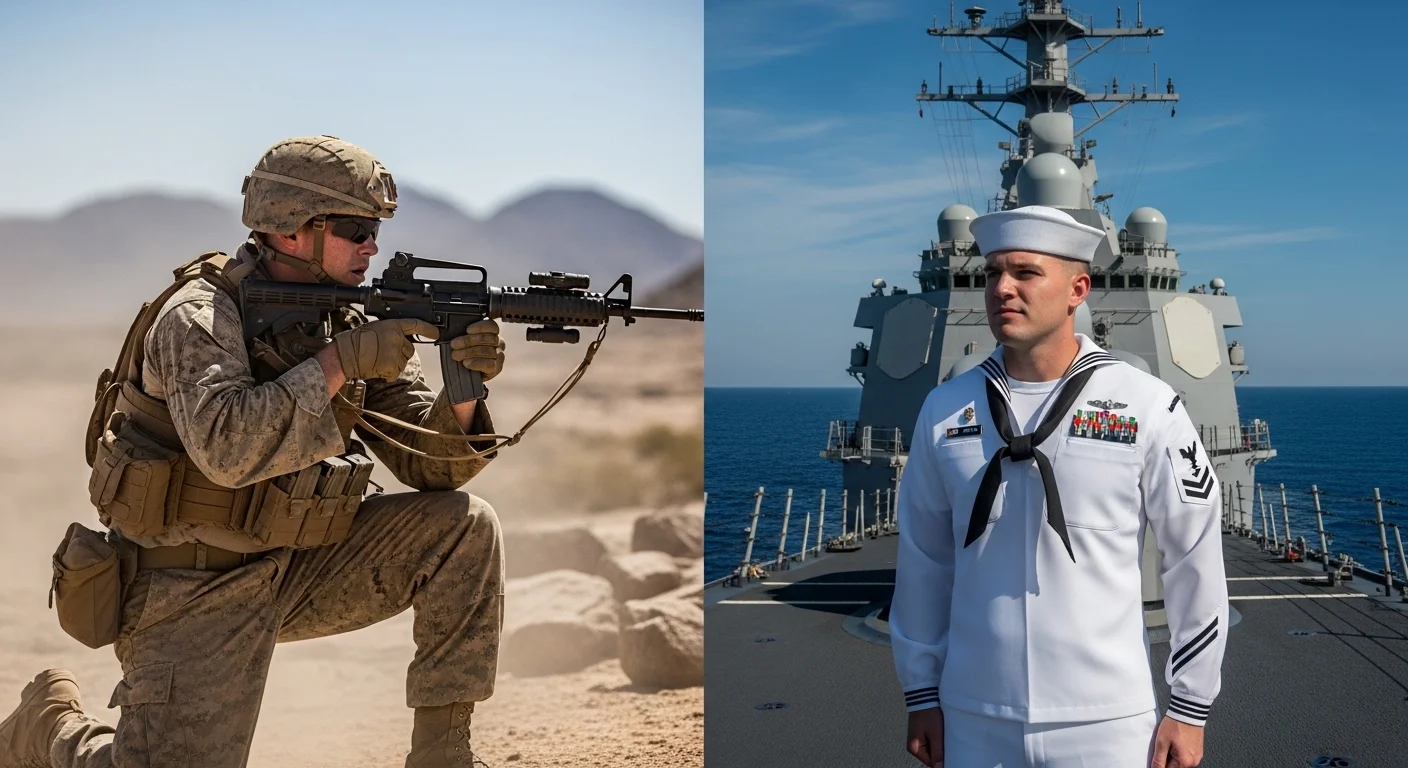
Difference between Marines and Navy is a topic that often raises curiosity, especially among readers interested in military structure and defense forces. Although both branches serve under the broader umbrella of naval power in many countries, the difference between Marines and Navy lies in their primary missions, training methods, and operational roles. While the Navy focuses mainly on controlling and protecting seas through ships, submarines, and aircraft, Marines are specialized forces trained to conduct rapid combat operations on land, particularly in coastal and amphibious environments.
Exploring the difference between Marines and Navy reveals how these two forces complement each other in modern military strategy. The Navy provides transportation, logistical support, and maritime security, enabling large-scale operations across oceans. In contrast, Marines are often the first troops deployed during crises, trained for swift assaults, expeditionary warfare, and securing strategic locations on land. Understanding the difference between Marines and Navy helps readers appreciate how these two branches work together to maintain national security and respond effectively to global challenges.
Pronunciation and Etymology
Marines
- US/UK: /məˈriːnz/ (muh-REENZ)
- Etymology: Latin mare (sea), via French marin and English “marine”—meaning “of the sea”
Navy
- US/UK: /ˈneɪvi/ (NAY-vee)
- Etymology: Latin navis (ship), via Old French navie—meaning “fleet of ships”
These linguistic roots reveal foundational divergence: Marines derive identity from connection to maritime environments, while Navy originates from vessel-centric operations.
Constitutional and Statutory Foundations
Legal Genesis and Service Status
The difference between Marines and Navy begins with constitutional authorization and statutory establishment:
United States Navy:
- Established: Constitutional Convention debates (1787), formalized by Naval Act of 1794
- Constitutional basis: Article I, Section 8 (Congressional power to provide and maintain Navy)
- Service status: Primary military service within Department of the Navy
- Secretary-level leadership: Secretary of the Navy (SECNAV) since 1798
- Uniformed leadership: Chief of Naval Operations (CNO) since 1915
United States Marine Corps:
- Established: November 10, 1775 (Continental Congress resolution)
- Constitutional basis: Article I, Section 8 (Congressional power to raise and support Armies)
- Service status: Secondary service within Department of the Navy (Title 10, U.S. Code, Section 5063)
- Command structure: Commandant of the Marine Corps reports to Secretary of the Navy; operates under Navy Department for administrative purposes but distinct for operational employment
Critical statutory distinction: While both services fall under Department of the Navy for administrative efficiency (National Security Act of 1947), the Marine Corps maintains separate identity as a “service in the Department of the Navy” rather than a subset thereof. This creates unique command relationships and operational reporting chains.
Ten Dimensions of Divergence: Operational, Organizational, and Strategic
1. Primary Warfighting Function
United States Navy:
Naval forces execute sea control, sea denial, power projection, and maritime security across global commons. Core functions include:
- Strategic nuclear deterrence (SSBN operations)
- Carrier strike group operations
- Submarine warfare (SSN/SSGN)
- Surface warfare and fleet air defense
- Mine countermeasures
- Maritime interdiction and constabulary functions
- 🟣 Example: Carrier Strike Group 12 conducts sustained flight operations in the South China Sea, maintaining air superiority and strike capability without terrestrial basing
- 🟣 Example: Submarine USS West Virginia executes strategic deterrent patrol, maintaining continuous at-sea nuclear capability since 1960
United States Marine Corps:
Marine forces conduct amphibious operations, crisis response, and specialized ground combat within littoral environments. Core functions include:
- Amphibious assault and raid operations
- Maritime prepositioning and force projection
- Security cooperation and theater security cooperation
- Specialized ground combat in contested maritime zones
- Close combat and urban operations
- Aviation combat element integration with ground schemes of maneuver
- 🟣 Example: 31st Marine Expeditionary Unit conducts amphibious assault exercise from USS America (LHA-6), seizing and securing beachhead for follow-on operations
- 🟣 Example: Marine Rotational Force-Darwin deploys company landing teams for theater security cooperation with Australian Defence Force
2. Force Structure and Manpower Composition
United States Navy:
- End strength: Approximately 340,000 active duty personnel (FY2024)
- Composition: Predominantly technical specialists aboard vessels and aviation platforms
- Officer/enlisted ratio: Higher proportion of officers due to technical command requirements
- Platform-centric organization: Personnel assigned to ships, submarines, aircraft squadrons, and shore installations
- Rating system: Enlisted personnel organized by technical specialties (ratings) such as Nuclear Machinist’s Mate, Aviation Electronics Technician
United States Marine Corps:
- End strength: Approximately 177,000 active duty personnel (FY2024; statutory floor of 186,000 temporarily adjusted)
- Composition: Combined arms teams integrating infantry, armor, artillery, aviation, and logistics
- Officer/enlisted ratio: Lower proportion of officers; emphasis on small-unit leadership
- Unit-centric organization: Personnel assigned to Marine Air-Ground Task Forces (MAGTFs)
- Military Occupational Specialty (MOS) system: Encompasses combat arms, combat support, and combat service support
Critical distinction: Navy organizes around platforms (ships, aircraft); Marines organize around combined-arms units (MAGTFs) capable of independent operations.
3. Command and Control Architecture
United States Navy:
- Operational command: Fleet commanders (U.S. Fleet Forces Command, U.S. Pacific Fleet, U.S. Naval Forces Europe/Africa)
- Functional component: Naval component commands to Geographic Combatant Commanders
- Service chief role: CNO serves as service chief and Joint Chiefs of Staff member; operational control flows through fleet commanders
United States Marine Corps:
- Operational command: Marine Corps Forces (MARFORs) to Geographic Combatant Commanders
- Service chief role: Commandant serves as service chief and Joint Chiefs member; also designated as “landing force” commander for naval operations per Title 10
- Unique dual-hat: Commandant responsible for service administration; operational control exercised through MARFORs or Marine Expeditionary Forces (MEFs)
Statutory nuance: Commandant maintains specific authority regarding Marine Corps organization and employment that Secretary of Navy cannot override without congressional notification (Title 10, Section 8063).
4. Operational Domain Focus
United States Navy:
- Primary domain: Maritime (sea and undersurface)
- Secondary domains: Air (naval aviation), space (satellite operations), cyber (Fleet Cyber Command), information environment
- Littoral interface: Supports but does not primarily execute ground combat ashore
- Strategic mobility: Self-deploying via organic platforms; unlimited range with logistics support
United States Marine Corps:
- Primary domain: Littoral (land-sea interface) and terrestrial
- Secondary domains: Air (Marine aviation), maritime (amphibious shipping), cyber (Marine Corps Cyberspace Command)
- Expeditionary mandate: Specifically designed for operations from sea to land and return
- Strategic mobility: Dependent on Navy amphibious shipping or strategic airlift; limited organic deployment capability
Emerging convergence: Both services pivoting toward “distributed maritime operations” and “expeditionary advanced base operations” (EABO) in contested littorals, but from different organizational starting points.
5. Training and Education Pipelines
United States Navy:
- Officer accessions: United States Naval Academy (Annapolis), Naval Reserve Officers Training Corps (NROTC), Officer Candidate School (OCS)
- Specialized training: Nuclear Power School, Naval Aviation training, Surface Warfare Officer School, Submarine Officer Basic Course
- Technical emphasis: Engineering, navigation, weapons systems, and platform-specific qualifications
- Enlisted training: Recruit Training Command (Great Lakes); technical training via “A” schools and “C” schools
United States Marine Corps:
- Officer accessions: United States Naval Academy (Marine option), NROTC (Marine option), Officer Candidates School (OCS—distinct from Navy OCS)
- Specialized training: The Basic School (TBS—mandatory for all officers regardless of MOS), Infantry Officer Course, Marine Aviation Training
- Combat emphasis: Every Marine a rifleman; all officers and enlisted complete Infantry Training Battalion or Marine Combat Training
- Enlisted training: Marine Corps Recruit Depots (Parris Island, San Diego); School of Infantry for all non-infantry MOS
Fundamental difference: Marine training emphasizes ground combat proficiency as universal baseline; Navy training emphasizes technical platform operation.
6. Equipment and Materiel Systems
United States Navy:
- Capital ships: Aircraft carriers (CVN), guided missile destroyers (DDG), cruisers (CG—being phased out), amphibious ships (LHD/LHA/LSD/LPD), submarines (SSN/SSBN/SSGN)
- Aircraft: F/A-18 Super Hornet, F-35C Lightning II, E-2D Hawkeye, MH-60 Seahawk, P-8A Poseidon
- Weapon systems: Tomahawk cruise missiles, Standard Missile family, torpedoes, naval gunfire (5-inch, 155mm Advanced Gun System on Zumwalt-class)
United States Marine Corps:
- Ground combat systems: M1A1 Abrams tank (being divested), Amphibious Combat Vehicle (ACV), Joint Light Tactical Vehicle (JLTV), M777 howitzer
- Aircraft: F-35B Lightning II (STOVL), F-35C Lightning II (carrier), AV-8B Harrier (being phased out), MV-22B Osprey, CH-53E/K King Stallion, UH-1Y/AH-1Z helicopters
- Unique systems: Landing Craft Air Cushion (LCAC), Amphibious Assault Vehicle (AAV—being replaced by ACV)
Acquisition divergence: Navy procures through Naval Sea Systems Command (NAVSEA) and Naval Air Systems Command (NAVAIR); Marines procure through Marine Corps Systems Command (MCSC), though both coordinate through Office of Naval Research and operational test agencies.
7. Expeditionary and Sustained Operations
United States Navy:
- Deployment model: Six-month deployments for carrier strike groups, submarine squadrons, and amphibious ready groups
- Sustainment: Self-sustaining via at-sea replenishment (UNREP/CONSOL); can remain deployed indefinitely with logistics support
- Shore establishment: Limited ground footprint; focus on port facilities and forward operating locations for aviation
United States Marine Corps:
- Deployment model: Unit Deployment Program (UDP), Marine Expeditionary Unit (MEU) six-month deployments, Special Purpose Marine Air-Ground Task Forces (SPMAGTFs)
- Sustainment: 30-day organic sustainment for MEUs; dependent on maritime prepositioning ships or logistics support area establishment ashore
- Shore establishment: Forward operating bases, embassy security compounds, and expeditionary airfields
Operational distinction: Navy sustains presence without territorial commitment; Marines seize and hold terrain requiring subsequent sustainment or extraction.
8. Special Operations Integration
United States Navy:
- Naval Special Warfare Command (NSW): SEAL Teams (Sea, Air, and Land), Special Boat Teams
- Mission sets: Direct action, special reconnaissance, counterterrorism, foreign internal defense, underwater special operations
- Integration: Supports theater special operations commands; operates globally from maritime platforms
United States Marine Corps:
- Marine Raiders (MARSOC): Critical Skills Operators and Special Operations Officers
- Mission sets: Foreign internal defense, counterinsurgency, special reconnaissance, direct action
- Integration: Marine Special Operations Command (MARSOC) component to U.S. Special Operations Command; maintains Marine Air-Ground Task Force integration capability
Structural difference: NSW operates as naval special operations force; MARSOC provides Marine-specific capabilities to SOCOM while maintaining service distinctiveness.
9. Relationship to Joint and Combined Operations
United States Navy:
- Functional combatant command: U.S. Transportation Command (USTRANSCOM) for sealift; U.S. Strategic Command (USSTRATCOM) for nuclear forces
- Geographic combatant commands: Provides naval component commanders (NAVCENT, NAVAF, etc.)
- Alliance integration: Combined maritime forces (CMF) for counter-piracy, ballistic missile defense
United States Marine Corps:
- Functional combatant command: U.S. Special Operations Command (MARSOC)
- Geographic combatant commands: Provides Marine component commanders (MARFORCENT, MARFORPAC, etc.)
- Alliance integration: Marine Rotational Forces (Australia, Norway, Japan); bilateral amphibious exercises
Unique Marine contribution: Designated “force of choice” for crisis response and limited contingency operations due to rapid deployment capability and integrated combined-arms structure.
10. Budgetary and Legislative Dynamics
United States Navy:
- Budget share: Approximately 28-30% of Department of Defense base budget (FY2024: ~$180 billion)
- Shipbuilding priority: Columbia-class SSBN, Ford-class CVN, Constellation-class FFG, Virginia-class SSN, DDG(X)
- Personnel costs: Lower per-capita costs due to larger force structure; higher platform acquisition costs
United States Marine Corps:
- Budget share: Approximately 8-10% of Department of Defense base budget (FY2024: ~$53 billion)
- Modernization priority: Force Design 2030 initiatives—long-range precision fires, unmanned systems, light amphibious warships, shore-based anti-ship missiles
- Personnel costs: Higher per-capita training costs; lower platform acquisition costs relative to Navy
Fiscal distinction: Navy requires sustained shipbuilding industrial base investment; Marines require flexible funding for rapid capability fielding and experimentation.
Organizational Culture and Identity
The Navy Ethos
The Navy cultivates a culture of technical excellence, global presence, and strategic patience. Sailors identify with their platforms—”ship’s company”—and develop deep expertise in complex systems. The service emphasizes “presence” as mission, maintaining continuous forward deployment to deter conflict and assure allies. Navy culture values engineering precision, navigation skill, and the ability to operate independently for extended periods. The tradition of “shipmates” creates tight bonds within crews, while the global nature of naval operations fosters cosmopolitan perspectives. The Navy sees itself as the “global force for good,” emphasizing humanitarian assistance and disaster response alongside combat capabilities.
The Marine Corps Ethos
The Marine Corps cultivates a culture of expeditionary readiness, small-unit leadership, and institutional toughness. Marines identify first as Marines, then by occupational specialty—”Every Marine a rifleman.” The service emphasizes “first to fight” and crisis response, maintaining high readiness for rapid deployment. Marine culture values physical fitness, marksmanship, and adaptability to ambiguous environments. The tradition of “esprit de corps” creates intense service pride and intergenerational connection through shared hardship. The Marines see themselves as “America’s 911 force,” emphasizing readiness to respond globally within hours or days rather than weeks.
Why Are People Confused About Their Use?
Confusion regarding the difference between Marines and Navy stems from several structural and historical factors:
Administrative Integration: Both services operate under the Department of the Navy, creating perception of subordination rather than partnership. Congressional appropriations combine Navy and Marine Corps funding in single budget line, obscuring distinct requirements.
Shared Platforms: Marines operate from Navy ships (amphibious assault ships, dock landing ships); Navy personnel crew these vessels while Marines constitute landing force. This operational integration masks organizational separation.
Historical Evolution: Marine Corps originally provided shipboard security and landing parties for naval vessels, creating functional overlap that persisted into the 20th century. Modern specialization has diverged missions but shared heritage remains.
Popular Culture Representation: Media frequently depicts Marines and sailors interchangeably or conflates their roles. Films like “Top Gun” (Navy) and “Full Metal Jacket” (Marines) receive similar cultural treatment despite distinct service contexts.
Joint Operations: Modern combat requires Navy-Marine integration (amphibious ready groups, Marine expeditionary units), making boundary lines operationally porous despite organizational clarity.
Clarification requires understanding that while Marines and Navy train, deploy, and fight together, they maintain distinct service cultures, legal authorities, and primary missions.
Comparison Matrix: Structural and Operational Parameters
| Parameter | United States Navy | United States Marine Corps |
|---|---|---|
| Establishment | 1794 (permanent), 1775 (Continental) | 1775 (Continental Congress) |
| Service Status | Primary service, Department of the Navy | Secondary service, Department of the Navy |
| Statutory Authority | Title 10, Sections 5062, 8062 | Title 10, Sections 5063, 8063 |
| End Strength (FY2024) | ~340,000 active duty | ~177,000 active duty |
| Primary Domain | Maritime (sea/undersea/air/space) | Littoral/terrestrial (air/land/sea interface) |
| Core Capability | Sea control, power projection, strategic deterrence | Amphibious operations, crisis response, combined arms |
| Organizational Unit | Ships, squadrons, task forces | Marine Air-Ground Task Forces (MAGTFs) |
| Service Chief | Chief of Naval Operations (CNO) | Commandant of the Marine Corps (CMC) |
| Budget Share | ~28-30% of DoD base | ~8-10% of DoD base |
| Deployment Model | Platform-based (6-month cycles) | Unit-based (MEU/UDP/rotational) |
| Special Operations | Naval Special Warfare (SEALs) | Marine Raiders (MARSOC) |
| Training Emphasis | Technical platform operation | Ground combat proficiency (universal) |
| Strategic Mobility | Self-deploying (organic platforms) | Dependent on Navy shipping/airlift |
Comparative Advantage: Contextual Employment
Employ Navy Forces When:
Strategic requirements demand sustained global presence without territorial commitment. Navy carrier strike groups provide continuous airpower and strike capability in international waters, avoiding host-nation basing agreements. Submarine forces offer stealthy intelligence collection, special operations support, and strategic nuclear deterrence. Surface forces conduct maritime security operations, freedom of navigation exercises, and humanitarian assistance/disaster response without requiring shore infrastructure. Navy expeditionary logistics enables joint force sustainment across vast distances. Choose Navy when the mission requires sea control, air superiority from maritime platforms, strategic nuclear deterrence, or global reach without ground force commitment.
Employ Marine Forces When:
Strategic requirements demand rapid crisis response with scalable force packages. Marine Expeditionary Units (MEUs) provide forward-deployed, self-sustaining combined-arms forces capable of amphibious assault, raid, or security cooperation missions within 24-72 hours notification. Specialized Marine units conduct embassy reinforcement, non-combatant evacuation operations, and theater security cooperation without requiring large-scale joint force deployment. Marine aviation integrated with ground forces enables ship-to-shore maneuver in contested environments. Choose Marines when the mission requires forcible entry from the sea, rapid crisis response with limited footprint, or combined-arms operations in littoral zones.
Integrated Employment:
Modern operational concepts (Distributed Maritime Operations, Expeditionary Advanced Base Operations) require Navy-Marine integration. Amphibious Ready Groups/Marine Expeditionary Units (ARG/MEUs) combine Navy amphibious shipping with Marine landing forces for flexible response options. Carrier strike groups integrate Marine F-35C squadrons for enhanced strike capability. Naval logistics supports Marine shore operations, while Marine shore-based anti-ship missiles extend fleet defense inshore.
Metaphorical and Conceptual Usage in Strategic Discourse
Navy Metaphors in Policy and Strategy:
- 🟣 “Carrier diplomacy” — Using naval presence to signal resolve without kinetic action
- 🟣 “Freedom of navigation” — Maintaining open global commons through naval operations
- 🟣 “Fleet in being” — Strategic deterrent effect of naval potential rather than active engagement
- 🟣 “Gunboat diplomacy” — Coercive use of naval power in crisis management
Marine Metaphors in Policy and Strategy:
- 🟣 “911 force” — Immediate crisis response capability
- 🟣 “First to fight” — Rapid deployment and expeditionary readiness
- 🟣 “Tip of the spear” — Forward-positioned, ready combat forces
- 🟣 “Few and proud” — Elite, selective service identity
Connotative Dimensions in National Discourse
Navy Connotations:
- 🟣 Positive: Global reach, technical sophistication, strategic patience, humanitarian assistance, nuclear deterrence stability
- 🟣 Negative: Expensive platforms, vulnerability to asymmetric threats, “gunboat diplomacy” imperialism associations
- 🟣 Neutral: Maritime, naval, seapower, presence
Example: “The Navy’s humanitarian response to the tsunami demonstrated soft power projection” (positive). “The Navy’s budget consumes resources needed for ground forces” (negative).
Marine Connotations:
- 🟣 Positive: Elite readiness, rapid response, small-unit leadership, institutional discipline, expeditionary capability
- 🟣 Negative: Institutional parochialism, “Marine exceptionalism,” resistance to joint integration, high personnel costs
- 🟣 Neutral: Amphibious, expeditionary, crisis response, combined arms
Example: “The Marines’ rapid deployment prevented escalation in the embassy crisis” (positive). “Marine resistance to force structure changes delays necessary modernization” (negative).
Institutional Idioms and Service Expressions
Navy Expressions:
- 🟣 “Fair winds and following seas” — Traditional blessing for safe voyage and successful career
- Example: “The retiring admiral received fair winds and following seas after forty years of service.”
- 🟣 “Don’t give up the ship” — Captain James Lawrence’s dying command; symbolizes perseverance
- Example: “Despite budget cuts, the program manager refused to give up the ship on the acquisition timeline.”
- 🟣 “Aye aye, sir” — Formal acknowledgment of orders
- Example: “When directed to accelerate the deployment, the commander responded ‘aye aye, sir’ immediately.”
- 🟣 “Bravo Zulu” — Naval signal meaning “well done”
- Example: “The crew received Bravo Zulu from the admiral for their performance during the exercise.”
Marine Expressions:
- 🟣 “Semper Fidelis” (Semper Fi) — “Always faithful”; official motto since 1883
- Example: “The veteran responded ‘Semper Fi’ when thanked for his service, indicating lifelong commitment.”
- 🟣 “Oorah” — Motivational expression of enthusiasm and agreement
- Example: “When ordered to deploy within 24 hours, the battalion responded with a resounding ‘oorah!'”
- 🟣 “Improvise, adapt, and overcome” — Unofficial motto reflecting expeditionary mindset
- Example: “Facing equipment shortages, the engineers improvised, adapted, and overcame to complete the mission.”
- 🟣 “Every Marine a rifleman” — Concept emphasizing universal combat readiness
- Example: “Even the administrative clerk qualified expert on the rifle range—every Marine a rifleman.”
Historical and Literary Treatment
Significant Works:
- 🟣 “The Influence of Sea Power upon History, 1660-1783” by Alfred Thayer Mahan (1890, strategic theory). Established navalism as grand strategy foundation; influenced U.S. Navy expansion and global basing structure.
- 🟣 “First to Fight: An Inside View of the U.S. Marine Corps” by Victor H. Krulak (1984, institutional history). Definitive analysis of Marine Corps organizational culture and interservice politics; standard reading for Marine officers.
- 🟣 “The Quiet Warrior: A Biography of Admiral Raymond A. Spruance” by Thomas B. Buell (1974, biography). Examines Navy command at Midway and Central Pacific campaign; illustrates Navy strategic leadership.
- 🟣 “With the Old Breed: At Peleliu and Okinawa” by E.B. Sledge (1981, memoir). Classic Marine combat narrative; basis for HBO’s “The Pacific”; captures Marine small-unit experience.
- 🟣 “The General’s Game Book” by Charles C. Krulak (1999, leadership). Marine Commandant’s treatise on strategic leadership and “strategic corporal” concept.
Cinematic and Documentary Representation
- 🟣 “Top Gun” (1986, USA) and “Top Gun: Maverick” (2022, USA). Iconic Navy aviation recruitment films; depict Naval Aviator culture, carrier operations, and technical excellence.
- 🟣 “The Pacific” (2010, USA). HBO miniseries following 1st Marine Division through Pacific War; companion to “Band of Brothers”; illustrates Marine amphibious operations and infantry combat.
- 🟣 “Act of Valor” (2012, USA). Feature film starring active-duty Navy SEALs; depicts Naval Special Warfare direct action and special reconnaissance missions.
- 🟣 “Generation Kill” (2008, USA). HBO miniseries following 1st Reconnaissance Battalion during 2003 Iraq invasion; examines Marine expeditionary operations and command challenges.
- 🟣 “Hunt for Red October” (1990, USA). Thriller depicting submarine warfare and naval intelligence; illustrates Navy strategic deterrence and undersea operations.
Frequently Asked Questions
Question 1: Are Marines part of the Navy?
Legally, administratively, but not operationally. The Marine Corps is a “service in the Department of the Navy” per Title 10, Section 5063. This means the Secretary of the Navy oversees Marine Corps administration, and both services share certain support functions (medical, legal, chaplaincy). However, the Commandant of the Marine Corps reports directly to the Secretary and President as a service chief, and Marine forces operate as distinct components to combatant commanders. The relationship is closer to partnership than subordination.
Question 2: Why does the Marine Corps exist if the Army conducts ground combat?
The Marine Corps provides unique capabilities: rapid deployment from sea without host-nation basing, integrated combined-arms organization at small scale, and specialized amphibious expertise. While the Army conducts sustained land campaigns, Marines specialize in crisis response, forcible entry, and operations in contested maritime environments. Statutory mandates (National Security Act of 1947) preserve Marine Corps as separate service to ensure these capabilities survive organizational competition.
Question 3: Can Navy personnel become Marines, or vice versa?
Yes, through inter-service transfer programs, though uncommon. Sailors may apply for Marine Corps commissioning programs (MECEP, ECP) or enlistment. Marines may transfer to Navy for specific technical ratings or commissioning. Both services maintain distinct cultures and training pipelines; transfers require adaptation to different professional expectations. Medical and chaplain corps personnel serve both services under Department of Navy.
Question 4: Which service sees more combat?
Depends on conflict type and era. Historically, Marine Corps maintained higher combat-to-personnel ratios due to smaller size and expeditionary focus. Since 2001, both services experienced sustained combat. Navy SEALs and special boat teams conducted continuous special operations. Marine units deployed to Iraq and Afghanistan for ground combat. Navy surface and aviation forces provided sustained support with limited direct combat exposure. Future high-end maritime conflict would likely expose Navy platforms to significant combat.
Question 5: How do Navy and Marine Corps budgets interact?
Department of Navy submits unified budget request, but distinct program elements track service-specific funding. Marine Corps receives “direct appropriations” for personnel, operations, and procurement, administered through Marine Corps commands. Navy receives analogous direct appropriations. Office of Secretary of Navy (OSN) oversees integration and resolves resource allocation disputes. Congress maintains separate oversight through authorization and appropriations committees. Force Design 2030 (Marine Corps modernization) and Next Generation Air Dominance (Navy aviation) represent current major investment areas.
We have more for your study here…..

Strategic Utility in National Security Architecture
Navy Contribution to Grand Strategy:
The Navy enables offshore balancing strategies, reducing requirements for permanent ground force presence in contested regions. Sea-based deterrence (SSBNs) provides survivable strategic nuclear forces. Naval power projection reduces dependence on fragile alliance networks for basing access. Maritime domain awareness and security cooperation build partner capacity without territorial commitment. The Navy’s global logistics network sustains joint force operations across vast distances.
Marine Contribution to Grand Strategy:
The Marine Corps provides strategic flexibility through forward-deployed, scalable force packages. MEU presence enables crisis response before escalation requires larger force commitment. Amphibious capability creates operational dilemmas for adversaries regarding coastal defense. Marine rotational forces strengthen alliances without permanent basing. Specialized crisis response capabilities (special purpose MAGTFs) address sub-threshold competition and irregular threats.
Integrated Strategic Effect:
Together, Navy and Marine Corps provide “options short of war” and escalation control mechanisms. Amphibious forces signal resolve without irreversible commitment. Naval presence enables rapid aggregation for major combat operations. The sea base (amphibious ships, prepositioning squadrons) reduces demand for vulnerable shore infrastructure. This combination supports integrated deterrence strategies and competitive approaches against peer adversaries.
Conclusion
The difference between Marines and Navy extends beyond organizational charts to fundamental approaches to warfare, service culture, and strategic utility. The Navy provides sustained global presence, sea control, and strategic deterrence through technically sophisticated platforms operated by specialized personnel. The Marine Corps provides rapid crisis response, amphibious forcible entry, and combined-arms ground combat through expeditionary units organized for independent operations. Both services operate under the Department of the Navy for administrative efficiency while maintaining distinct identities, statutory authorities, and operational roles. Understanding these differences enables effective force employment, appropriate capability investment, and coherent strategic planning. As the United States confronts peer competition in the Indo-Pacific and sustained global instability, the complementary capabilities of Navy and Marine Corps remain essential to national security. More at….

The author is a Ph.D scholar and has keen interest in what is happening around the world. I love to write, travel and observe. Constant zeal for new ideas is a trigger for me. Love, respect and live peacefully