

Difference between Murder and Manslaughter and difference between murder and manslaughter is an essential legal topic that helps distinguish between varying levels of criminal intent in cases of unlawful killing. At first glance, both terms may seem similar because they involve the act of causing someone’s death. However, the law draws a sharp and meaningful line between them based on intention, circumstances, and state of mind.
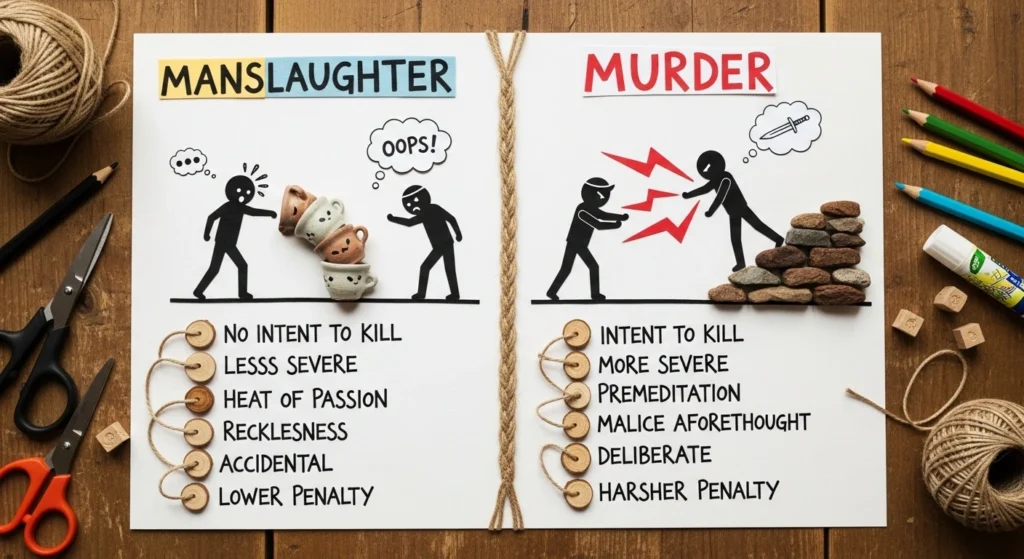
To clarify, the difference between murder and manslaughter primarily lies in intent and premeditation. Murder typically involves deliberate planning or a clear intention to cause harm, whereas manslaughter often occurs without prior intent, sometimes in the heat of the moment or due to negligence. Therefore, understanding the difference between murder and manslaughter not only deepens legal awareness but also highlights how justice systems evaluate human behavior under different conditions.
One word—intent—can be the difference between walking free someday and dying behind bars.
In the criminal justice system, no distinction is more consequential, more debated, or more misunderstood than the difference between murder and manslaughter. These aren’t just legal categories—they’re life-defining labels that determine whether you’ll face 20 years or life without parole, whether society sees you as irredeemable or recklessly tragic, whether you’ll ever hug your family again outside prison walls.

The stakes couldn’t be higher. Yet most people blur these distinctions, using “murder” as a catch-all for any killing. This confusion isn’t just academic—it shapes jury decisions, influences plea bargains, and determines the trajectory of countless lives caught in the system’s gears.
Let’s dissect the anatomy of homicide with surgical precision. By understanding the difference between manslaughter and murder, you’ll grasp how the law weighs human life, judges moral culpability, and distinguishes between evil intent and tragic error.
The Foundation: Understanding Criminal Homicide
Before distinguishing murder from manslaughter, we must understand what unites them. Both fall under criminal homicide—the unlawful killing of another human being. The “unlawful” element is critical: not all killings are crimes. Self-defense, accidents without criminal negligence, and state-sanctioned executions are killings that don’t trigger criminal liability.
Criminal homicide charges exist on a spectrum of moral blameworthiness, determined primarily by the defendant’s mens rea—the mental state at the moment of killing . This Latin term for “guilty mind” is the Rosetta Stone of homicide law.
Murder: The Crown Jewel of Criminal Law
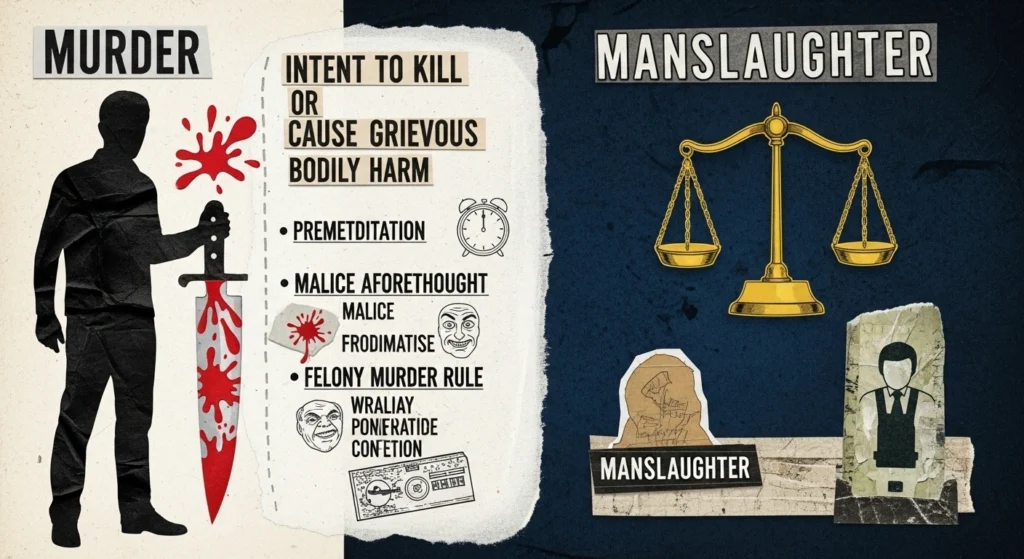
Murder represents the most serious form of criminal homicide, defined by the presence of malice aforethought . This archaic-sounding term is the legal system’s way of identifying killers who acted with either:
- Express malice: The specific intent to kill
- Implied malice: Conscious disregard for human life (“depraved indifference”)
Critically, malice aforethought doesn’t require hatred or ill will—it’s a technical legal term describing a mental state, not an emotion . You can murder someone you love if you act with intent to kill or extreme recklessness.
First-Degree Murder: The Calculated Kill
First-degree murder sits at the apex of the homicide hierarchy. It requires willful, deliberate, and premeditated killing . The killer didn’t just intend death—they thought about it, planned it, and executed that plan.
Key elements:
- Intent: Conscious objective to cause death
- Deliberation: Weighed the pros and cons
- Premeditation: Planned before acting (even seconds count, but longer planning strengthens the charge)
Examples:
- Lying in wait to ambush a victim
- Poisoning someone over weeks
- Hiring a hitman
- Drive-by shootings targeting specific individuals
Penalties: 25 years to life, life without parole, or death penalty (where applicable)
Second-Degree Murder: The Intentional but Unplanned Kill
Second-degree murder covers intentional killings without premeditation, or deaths caused by extreme indifference to human life . The killer meant to kill or acted with “depraved heart” disregard for whether death resulted.
Key distinctions from first-degree:
- No advance planning
- Often occurs in the heat of the moment
- Intent formed immediately before or during the act
Examples:
- Firing a gun into a crowd without targeting anyone specific
- Punching someone with such force that death results, showing extreme indifference
- Killing during a sudden rage without prior planning
Penalties: 15 years to life in California; varies by state
The Felony Murder Rule: Intent by Association
Under the felony murder rule, a killing during the commission of certain dangerous felonies (robbery, burglary, arson, kidnapping, rape) constitutes murder even without intent to kill . If your accomplice shoots someone during a bank robbery, you both face murder charges. The logic: creating grave risks to life during felonies demonstrates implied malice.
Manslaughter: When Killing Falls Short of Murder
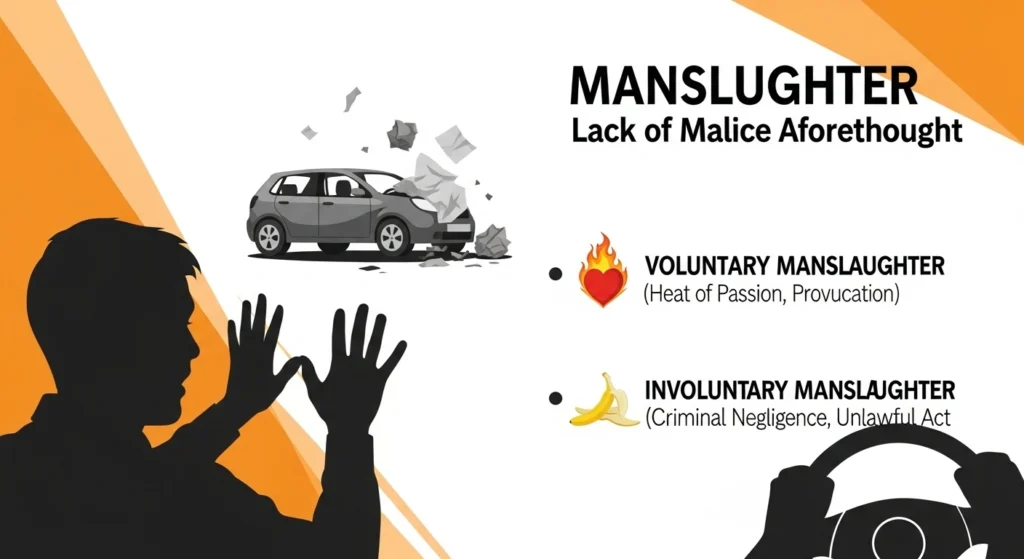
Manslaughter occupies the middle ground—unlawful killings without malice aforethought. The defendant caused death, but their mental state was less blameworthy than murder requires . The law recognizes two primary categories, distinguished by intent and emotional context.
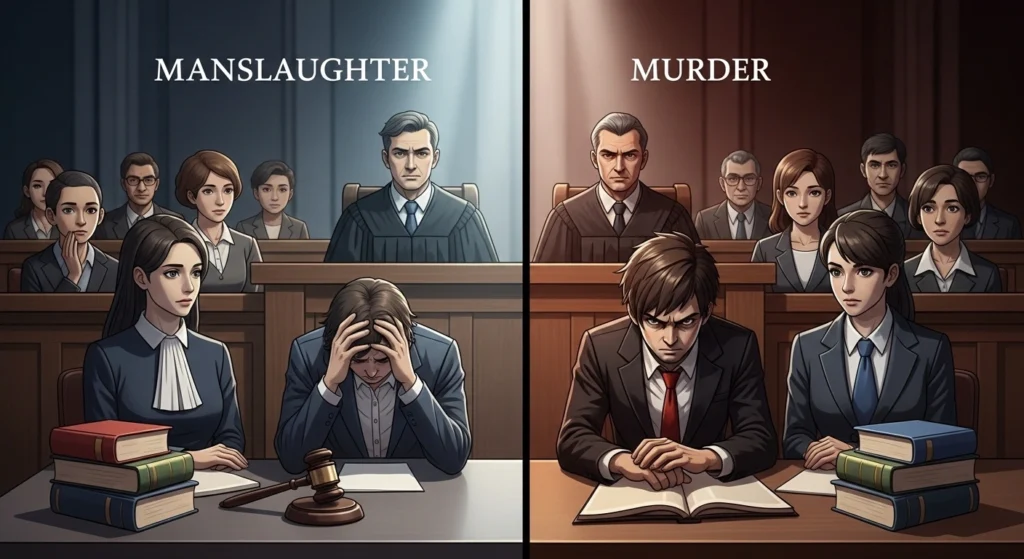
Voluntary Manslaughter: The Heat of Passion Kill
Voluntary manslaughter occurs when someone intentionally kills in the heat of passion following adequate provocation . The defendant meant to kill, but their judgment was so compromised by emotion that the law treats them less harshly than cold-blooded murderers.
Critical elements:
- Adequate provocation: Something that would cause a reasonable person to lose self-control (catching a spouse cheating, being violently attacked)
- Heat of passion: Rage, terror, or extreme emotional disturbance
- No cooling-off period: The killing occurred before the defendant could regain composure
- Causal connection: The provocation directly caused the passion that caused the killing
Real-world scenario: You walk in on your spouse with another person, snap, and kill them in a blind rage. You intended to kill, but you didn’t plan it—you were temporarily boiling with emotion .
Why reduce murder to voluntary manslaughter? The law recognizes that humans aren’t always rational agents. When emotions overwhelm reason, moral culpability diminishes. However, this isn’t a complete excuse—just a partial defense that reduces the charge .
Penalties: Typically 2-20 years, though some states allow up to 20 years or more depending on aggravating factors
Involuntary Manslaughter: The Unintentional Kill
Involuntary manslaughter covers unintentional killings resulting from recklessness or criminal negligence . The defendant didn’t mean to kill anyone, but their conscious disregard of serious risks—or their gross deviation from reasonable care—caused death.
Two primary forms:
1. Reckless involuntary manslaughter: Defendant was aware of a substantial risk of death but consciously disregarded it
- Texting while driving and killing a pedestrian
- Recklessly handling a loaded firearm
- Administering dangerous drugs without medical training
2. Criminal negligence manslaughter: Defendant failed to recognize an obvious risk that a reasonable person would have perceived
- Leaving a child in a hot car
- Failing to secure a swimming pool with a broken gate
- Severe medical neglect
Key distinction from murder: No malice aforethought—no intent to kill and no conscious disregard for human life amounting to “depraved indifference.” The defendant was careless or reckless, not murderous .
Penalties: Generally 2-20 years, though some states classify it as a misdemeanor with lighter sentences
The Critical Distinctions: A Comparative Matrix
| Element | First-Degree Murder | Second-Degree Murder | Voluntary Manslaughter | Involuntary Manslaughter |
|---|---|---|---|---|
| Intent to Kill | Yes, premeditated | Yes, not premeditated | Yes, but heat of passion | No |
| Malice Aforethought | Express or implied | Express or implied | Absent (mitigated by passion) | Absent |
| Premeditation | Yes | No | No | No |
| Mental State | Willful, deliberate, premeditated | Intentional or depraved indifference | Intentional but provoked/emotional | Reckless or criminally negligent |
| Provocation | Irrelevant | Irrelevant | Required (adequate cause) | Irrelevant |
| Typical Penalty | 25 years-life/death | 15 years-life | 2-20 years | 2-20 years (or less) |
| Example | Hiring a hitman | Shooting into a crowd | Killing spouse’s lover in rage | Texting while driving, killing pedestrian |
State-by-State Variations: The Legal Patchwork
While the murder/manslaughter framework is universal, specifics vary dramatically by jurisdiction:
Texas Approach
- Murder: Intentional or knowing conduct (first-degree felony: 5-99 years or life)
- Manslaughter: Reckless conduct (second-degree felony: 2-20 years)
- Criminally Negligent Homicide: Criminal negligence (state jail felony: 180 days-2 years)
- No distinction between voluntary and involuntary manslaughter—both are simply “manslaughter”
Pennsylvania Approach
- Voluntary Manslaughter: First-degree felony (up to 20 years)
- Involuntary Manslaughter: First-degree misdemeanor (up to 5 years) unless victim under 12 in defendant’s care, then second-degree felony (up to 10 years)
Georgia Approach
- Voluntary Manslaughter: Up to 20 years
- Involuntary Manslaughter: 1-10 years if during unlawful act; up to 12 months if during lawful act performed unlawfully
California Approach
- No third-degree murder (unlike Florida, Pennsylvania, and Minnesota)
- Uses degrees of murder (first/second) plus manslaughter categories (voluntary/involuntary/vehicular)
The Defense Strategy: Fighting the Charge
Understanding these distinctions isn’t academic—it’s the foundation of criminal defense. Common strategies include:
Reducing Murder to Manslaughter
Heat of passion defense: Argue the defendant acted under sudden, intense emotional disturbance with adequate provocation, negating malice aforethought
Imperfect self-defense: The defendant honestly but unreasonably believed deadly force was necessary. In some jurisdictions, this reduces murder to voluntary manslaughter
Reducing Manslaughter to Lesser Charges
Accident defense: The killing was truly accidental with no recklessness or criminal negligence—completely lawful behavior
Challenging recklessness: Argue the defendant wasn’t consciously disregarding risks, or that the deviation from reasonable care wasn’t “gross” enough for criminal liability
Complete Defenses
Self-defense/defense of others: Justified killing to prevent imminent death or serious bodily harm
Insanity: The defendant lacked capacity to understand their actions or distinguish right from wrong
Alibi/mistaken identity: The defendant didn’t commit the killing
The Moral Architecture: Why These Distinctions Matter
The murder/manslaughter framework reflects society’s attempt to align punishment with moral culpability. Consider the philosophical distinctions:
Murderers acted with “malice aforethought”—they either wanted death or didn’t care if it resulted. They made a choice to kill or to create conditions where killing was likely. Their punishment reflects society’s judgment that such choices deserve the harshest sanctions.
Voluntary manslaughter defendants also chose to kill, but their choice was compromised by extreme emotion. The law acknowledges that humans aren’t purely rational—that passion can temporarily override judgment. The reduced sentence recognizes diminished but not absent moral responsibility.
Involuntary manslaughter defendants never chose to kill. Their moral failing was carelessness, recklessness, or gross negligence. They deserve punishment for causing death, but not the same punishment as those who intentionally took life.
Real-World Consequences: Why Definitions Determine Destinies
The difference between manslaughter and murder isn’t semantic—it shapes lives:
Scenario 1: A man finds his wife cheating, leaves, returns an hour later with a gun, and kills her. First-degree murder—time to cool off negates heat of passion defense. Life in prison.
Scenario 2: Same man walks in on the affair, snaps immediately, and kills in a blind rage. Voluntary manslaughter—heat of passion with no cooling-off period. 2-20 years.
Scenario 3: Same man, driving away emotionally distraught, runs a red light while texting and kills a pedestrian. Involuntary manslaughter—reckless but no intent to kill. 2-20 years (or less).
Scenario 4: Same man deliberately runs over the lover with his car. Second-degree murder—intentional but unplanned. 15 years to life.
Four scenarios, four radically different outcomes, all hinging on intent, timing, and mental state.
Conclusion: Knowledge as Power
The distinction between manslaughter and murder represents one of criminal law’s most consequential classifications. It separates calculated evil from tragic passion, intentional killing from reckless accident, those who chose death from those who failed to prevent it.
For defendants, understanding these distinctions can mean decades of difference in prison time. To jurors, it means the weight of determining whether someone is a murderer or a tragic figure. For society, it represents our collective judgment about when killing deserves the ultimate punishment versus when mercy is warranted.
The law recognizes what we intuitively understand: not all killings are morally equivalent. The difference between manslaughter and murder is the difference between a life defined by a moment’s rage and one defined by cold calculation—and our justice system, imperfect as it is, attempts to honor that distinction. More at…
If you or someone you know faces homicide charges, understanding these distinctions is only the first step. Consult an experienced criminal defense attorney immediately—the specific charge and how it’s defended can shape the rest of your life .
The line between manslaughter and murder may be thin, but crossing it changes everything.
Conclusion
In conclusion, the difference between murder and manslaughter reflects how the law carefully considers intent, emotion, and responsibility when judging unlawful killings. While both involve the loss of life, the degree of intent significantly affects how each crime is defined and punished.
Ultimately, recognizing the difference between murder and manslaughter allows for a clearer understanding of legal principles and moral accountability. By distinguishing between deliberate actions and unintended consequences, the justice system aims to ensure fair and proportionate outcomes in even the most serious cases.

The author is a Ph.D scholar and has keen interest in what is happening around the world. I love to write, travel and observe. Constant zeal for new ideas is a trigger for me. Love, respect and live peacefully