
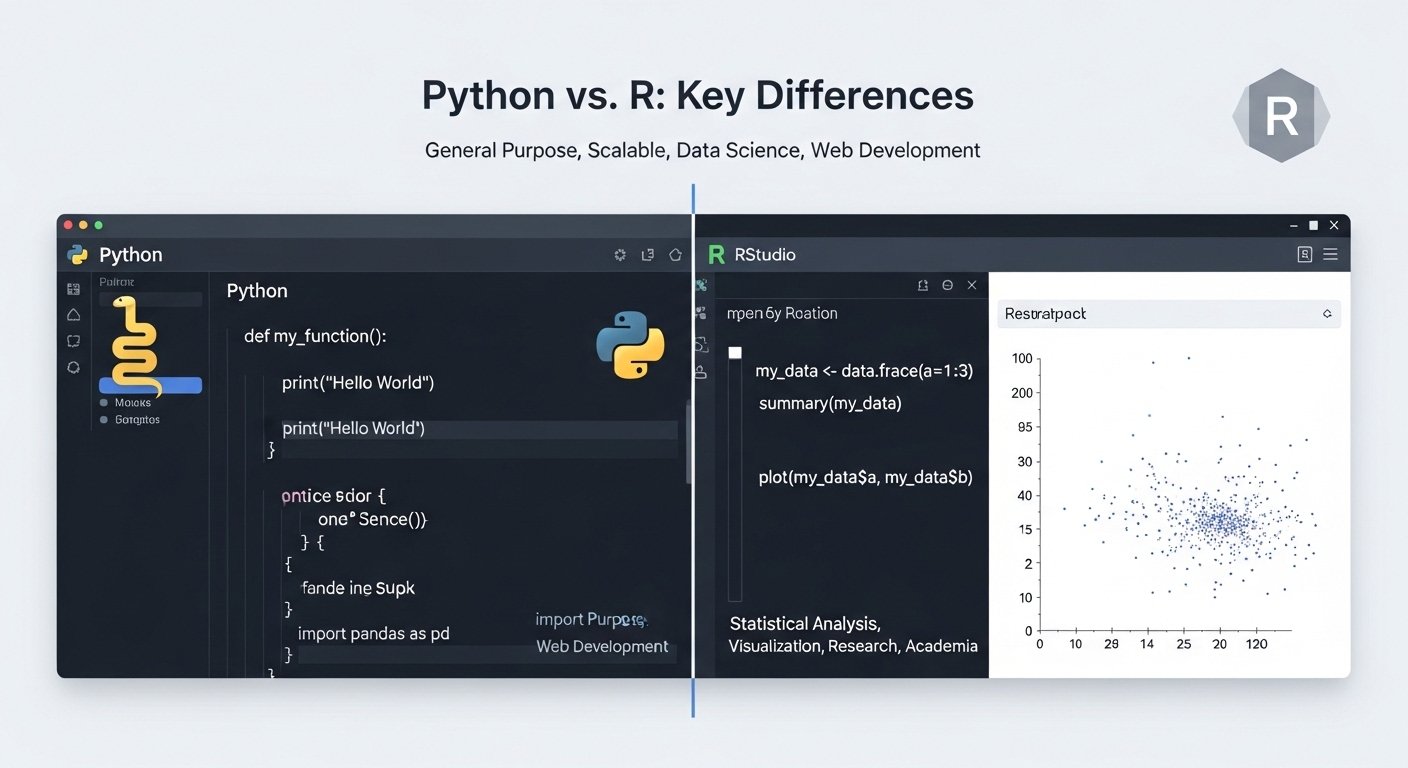
A marketing company wanted to understand customer behavior. One analyst used Python to build an automated prediction system. Another analyst used R Language to study patterns and create detailed graphs. Both solved the same problem but used different tools. This story explains the difference between Python and R Language in real life. Python works like a universal tool for many tasks, while R Language focuses deeply on statistics and data analysis.
Today, the difference between Python and R Language matters for students entering data science and research fields. Many beginners struggle because they do not understand the difference between Python and R Language before learning programming. Knowing the difference between Python and R Language helps learners choose the right skill and helps experts apply the best tool for real-world problems.
Key Difference Between the Both
Python is a general-purpose programming language.
R Language is mainly designed for statistical computing and data analysis.
Why Is Their Difference Necessary to Know for Learners and Experts?
Understanding their difference saves learning time. Students can focus on skills needed for careers like data science, artificial intelligence, or research. Industries depend on correct tool selection for efficiency. Researchers prefer accurate statistical tools, while developers need flexible programming systems. Society benefits when data solutions become faster and more reliable.
Pronunciation
Python
• US: /ˈpaɪ.θɑːn/
• UK: /ˈpaɪ.θən/
R Language
• US: /ɑːr ˈlæŋ.ɡwɪdʒ/
• UK: /ɑː ˈlæŋ.ɡwɪdʒ/
Difference Between Python and R Language
1. Purpose
Python serves as a multi-purpose programming language that handles a wide range of tasks. In contrast, R Language is mainly built for statistical analysis and data interpretation. Therefore, Python supports complete system development, while R concentrates on understanding data deeply.
Examples:
• Python is used to build websites and automation tools.
• R is used to perform statistical modeling in research studies.
2. Learning Curve
Python is generally easier for beginners because its syntax is simple and readable. On the other hand, R requires basic knowledge of statistics, which may slow early learning. However, once statistical concepts are clear, R becomes highly powerful.
Examples:
• Beginners quickly learn Python commands and scripts.
• Researchers apply R formulas for experimental analysis.
3. Usage Area
Python plays a major role in artificial intelligence, automation, and software systems. Meanwhile, R Language is widely used in academic and scientific environments where data interpretation is essential.
Examples:
• Python powers machine learning applications.
• R analyzes clinical or medical datasets.
4. Data Visualization
R provides highly specialized and detailed graphical tools for statistical presentation. Python, however, offers flexible visualization that fits dashboards and applications.
Examples:
• R creates advanced charts using ggplot.
• Python builds interactive dashboards using visualization libraries.
5. Community Support
Python enjoys a massive global developer community across industries. In comparison, R has a focused but strong community mainly formed by statisticians and researchers.
Examples:
• Python users share solutions on developer forums.
• R communities discuss academic data problems.
6. Performance
Python performs efficiently in large-scale systems and production environments. Conversely, R excels when performing deep statistical calculations and simulations.
Examples:
• Python runs backend automation systems.
• R conducts statistical simulations for research projects.
7. Libraries
Python libraries cover many domains such as AI, web development, and automation. R libraries mainly specialize in analytics and statistical computation.
Examples:
• TensorFlow supports machine learning in Python.
• dplyr simplifies data analysis in R.
8. Integration
Python integrates smoothly with software applications and web technologies. R integrates strongly with statistical platforms and research tools.
Examples:
• Python connects with web applications and APIs.
• R works with analytical and reporting software.
9. Industry Adoption
Python dominates commercial and industrial projects due to its versatility. In contrast, R remains highly popular within universities and research institutions.
Examples:
• Technology companies use Python for analytics systems.
• Universities rely on R for academic research.
10. Career Path
Python supports careers in software development, artificial intelligence, and data engineering. R mainly supports careers focused on statistics and research analysis.
Examples:
• Python skills lead to data engineer roles.
• R expertise supports biostatistician careers.
Nature and Behaviour of Both
Python:
Python is flexible, adaptive, and solution-oriented. It behaves like a universal toolbox that fits many industries, from web development to artificial intelligence.
R Language:
R Language is analytical, precise, and research-driven. It behaves like a scientific instrument designed to examine data carefully and produce accurate conclusions.
Why Are People Confused About Their Use?
Confusion arises because both Python and R are widely used in data science. Many courses teach them side by side, and job descriptions frequently request knowledge of both languages. As a result, beginners often assume they perform identical roles. In reality, Python focuses more on system development and automation, whereas R emphasizes statistical understanding and analytical depth.
Difference and Similarity Table
| Aspect | Python | R Language | Similarity |
|---|---|---|---|
| Type | General-purpose | Statistical | Programming |
| Ease | Easy | Moderate | Data handling |
| Use | AI & automation | Statistics | Analysis |
| Industry | High | Academic | Data science |
| Visualization | Flexible | Advanced | Graph creation |
Which Is Better in What Situation?

Python is better when projects demand automation, machine learning, web development, or artificial intelligence solutions. In such situations, Python smoothly connects different software systems, making development faster and more efficient. Moreover, companies prefer Python because it integrates easily with applications, databases, and cloud platforms. As a result, organizations can build scalable and intelligent systems without unnecessary complexity. At the same time, beginners feel comfortable learning Python due to its clear and readable syntax. Therefore, Python becomes a practical starting point for students who aim for long-term career growth in technology and data-driven industries.
R Language is better, on the other hand, when projects require deep statistical analysis or academic research accuracy. Researchers, economists, and healthcare analysts rely on R because it provides powerful tools for data modeling, hypothesis testing, and advanced visualization. In addition, R allows analysts to explore patterns with high precision, which is essential in scientific studies and policy research. Consequently, when correct interpretation of data matters more than system automation, R becomes the stronger choice. For this reason, R remains highly valued in universities, research labs, and evidence-based decision environments.
How Are Python and R Language Used in Metaphors and Similes?
• Python is called a Swiss army knife of programming.
• R Language is seen as a microscope for data.
Examples:
• “Python opened many technological doors.”
• “R examined data with scientific precision.”
Connotative Meaning
Python
Positive: flexibility, innovation
Neutral: programming tool
Negative: overused in simple scripts
Example: Python powered modern AI systems.
R Language
Positive: accuracy, research strength
Neutral: statistical language
Negative: steep learning curve
Example: R Language improved medical data analysis.
Idioms or Proverbs Related
• Right tool for the job
Example: Python or R Language depends on choosing the right tool for the job.
• Knowledge is power
Example: Learning both languages proves knowledge is power in data science.
Works in Literature
• Python for Data Analysis
Genre: Technical
Writer: Wes McKinney
Year: 2012
• The R Book
Genre: Statistical Computing
Writer: Michael Crawley
Year: 2007
Movies Related to the Keywords
• The Social Network (2010, USA)
• Ex Machina (2014, UK)
• Moneyball (2011, USA)
• The Imitation Game (2014, UK/USA)
Frequently Asked Questions
1. Is Python better than R?
Not always. In fact, the answer depends greatly on the project goal. If the task involves automation, artificial intelligence, or software development, Python often becomes the preferred choice. However, when deep statistical testing or academic research is required, R proves more suitable. Therefore, instead of asking which is better, it is wiser to ask which language fits the problem more effectively.
2. Which language is easier?
Generally, Python is easier for beginners because its syntax reads almost like simple English. As a result, new learners understand coding logic faster. On the other hand, R may feel complex at first since it follows statistical thinking. Still, once learners understand data concepts, R becomes powerful and rewarding.
3. Do data scientists use both?
Yes, and increasingly so. Modern data scientists often combine Python and R to gain the advantages of both worlds. For example, they may clean and deploy models using Python while performing advanced statistical analysis in R. Thus, using both languages creates flexibility and efficiency.
4. Is R only for statistics?
Mostly yes, yet not entirely. Although R was designed for statistical computing, it can also handle data visualization, reporting, and even web applications. Consequently, R has evolved beyond pure statistics and now supports broader analytical tasks.
5. Which language has more jobs?
Currently, Python offers wider job opportunities because industries such as artificial intelligence, cybersecurity, automation, and web development rely heavily on it. Meanwhile, R remains highly valued in research fields like healthcare, finance, and academia. Hence, job availability often depends on industry demand rather than language superiority.
How Are Both Useful ?
Python quietly operates behind many everyday technologies. It powers recommendation systems, smart assistants, traffic prediction tools, and automated services that people use daily. Meanwhile, R Language strengthens decision-making in hospitals, economic policy planning, environmental studies, and scientific discovery. When combined, Python builds intelligent systems, while R ensures those systems rely on accurate data understanding. Together, they help governments, businesses, and researchers make informed choices that improve modern living conditions.
Final Words for Both
Python turns ideas into working systems.
R Language turns raw numbers into meaningful insight.
Conclusion
The difference between Python and R Language rests mainly on flexibility versus specialization. Python acts as a versatile engine that drives automation, artificial intelligence, and large-scale applications across industries. In contrast, R Language excels in statistical precision and analytical depth, making it highly valuable for researchers and analysts. Rather than competing, both languages complement each other in the modern data ecosystem. Learners who understand when and how to use each tool gain a strong advantage. Ultimately, mastering Python and R together allows professionals to move from simple data handling toward intelligent innovation and evidence-based decision-making.

The author is a Ph.D scholar and has keen interest in what is happening around the world. I love to write, travel and observe. Constant zeal for new ideas is a trigger for me. Love, respect and live peacefully