
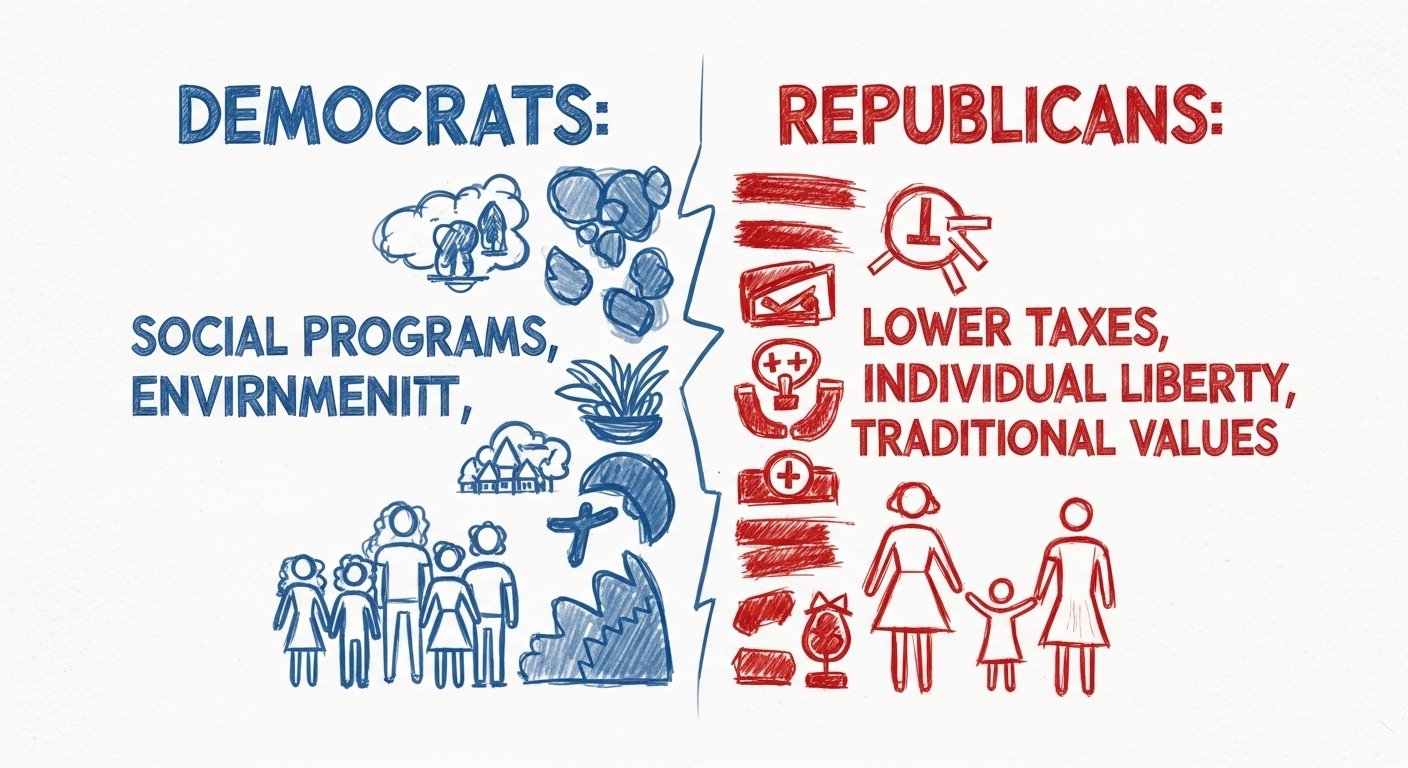
The difference between Republicans and Democrats can be observed in everyday conversations, such as a town meeting in the United States where two neighbors debated how taxes should be used. For instance, one argued for lower taxes and greater business freedom, whereas the other advocated for increased public services, including healthcare and education. While both wanted the country to thrive, their priorities clearly diverged. Consequently, this simple scenario effectively illustrates how these two major political parties not only shape most American policies but also influence elections and guide national debates on critical issues.
Furthermore, understanding the difference between Republicans and Democrats is crucial for citizens who wish to follow the news, participate actively in elections, or fully comprehend government decisions. In addition, many students, first-time voters, and international observers often hear political debates without grasping the real distinctions between these parties. Therefore, by knowing the difference between Republicans and Democrats, people can better interpret policies, anticipate voting behavior, and understand the country’s political direction more clearly. Moreover, this knowledge enables citizens to engage in informed discussions, make thoughtful decisions, and avoid being misled by oversimplified media narratives.
Pronunciation
Republicans
• US: /rɪˈpʌb.lɪ.kənz/
• UK: /rɪˈpʌb.lɪ.kənz/
Democrats
• US: /ˈdem.ə.kræts/
• UK: /ˈdem.ə.kræts/
Difference Between Republicans and Democrats
Difference Between Republicans and Democrats
1. Economic Policy
When it comes to economic policy, Republicans generally favor free markets, believing that minimal government intervention encourages growth, entrepreneurship, and innovation. On the other hand, Democrats often advocate for regulation to protect workers, consumers, and the environment while promoting fair opportunities for all citizens.
Examples:
• Republicans support tax reductions for businesses to encourage investment and job creation.
• Democrats fund public programs, such as unemployment benefits and social welfare initiatives, to reduce inequality.
Therefore, understanding these approaches allows citizens to see how policy decisions affect both markets and everyday life, highlighting the practical consequences of each ideology.
2. Government Size
The parties differ sharply in how they view the role of government. Republicans prefer a smaller government, arguing that fewer regulations allow individuals and businesses to thrive. Conversely, Democrats favor a larger, service-oriented government providing health, education, and social programs to support citizens.
Examples:
• Republicans advocate for reduced federal oversight in state matters.
• Democrats work toward expanding healthcare programs and social services for the public.
Thus, the contrast reflects a fundamental difference in philosophy: personal responsibility versus collective support.
3. Taxation
Tax policy further illustrates the divide. Republicans support lower taxes, especially for businesses and higher-income individuals, believing this stimulates economic growth. In contrast, Democrats favor progressive taxation, where wealthier citizens contribute more to fund public programs.
Examples:
• Republicans implement tax cuts for investors to encourage entrepreneurship.
• Democrats increase taxes on wealthy groups to fund schools and hospitals.
Through taxation, both parties attempt to balance economic priorities, though their methods and goals differ significantly.
4. Healthcare Approach
Healthcare policy is another defining issue. Republicans typically favor private healthcare systems, allowing citizens to choose insurance plans based on personal preference and market competition. Meanwhile, Democrats emphasize public access, supporting programs that make healthcare more affordable and inclusive.
Examples:
• Republicans promote private insurance choice to encourage competition.
• Democrats implement government-supported insurance plans, such as Medicaid expansion.
This distinction highlights the tension between personal responsibility and collective welfare in American politics.
5. Social Policies
Social issues reveal the ideological differences between the parties. Republicans often uphold traditional values, emphasizing family, religion, and social norms. In contrast, Democrats focus on social equality and reforms, advocating civil rights, gender equality, and LGBTQ+ protections.
Examples:
• Republicans emphasize family traditions and conservative cultural values.
• Democrats support initiatives expanding civil rights and social justice.
These differing perspectives influence legislation, cultural debates, and public discourse nationwide.
6. Environmental Policy
Environmental priorities also show a clear divide. Republicans often prioritize economic growth over environmental regulations, arguing that energy industries and businesses drive prosperity. Meanwhile, Democrats emphasize climate change mitigation and sustainable policies.
Examples:
• Republicans support energy industries like coal and oil for economic stability.
• Democrats enact climate change regulations to reduce carbon emissions.
Consequently, this contrast frequently appears in debates over energy policy, infrastructure, and long-term planning.
7. Immigration Views
Immigration policy is another point of difference. Republicans favor stricter immigration controls to protect borders and national security. On the other hand, Democrats support comprehensive immigration reforms, including pathways to citizenship and integration programs.
Examples:
• Republicans implement strong border security measures.
• Democrats propose programs to grant legal status to undocumented immigrants.
Thus, the debate reflects differing priorities between national security and humanitarian concerns.
8. Education Policy
Education policy mirrors the parties’ philosophies. Republicans advocate for school choice, charter schools, and local control, emphasizing competition and accountability. Meanwhile, Democrats support public education funding to strengthen schools and ensure access for all children.
Examples:
• Republicans expand charter schools to foster innovative learning.
• Democrats increase public school budgets for teachers, resources, and programs.
Therefore, these differences directly affect how communities experience education.
9. Foreign Policy
Foreign policy also highlights contrasting priorities. Republicans often stress national strength and military investment, believing a strong defense ensures security. Democrats emphasize diplomacy and international cooperation, promoting alliances and global partnerships.
Examples:
• Republicans allocate more funds for military modernization.
• Democrats participate in international treaties and climate agreements.
These approaches shape how the U.S. interacts with the world and maintains influence globally.
10. Political Symbol
Even symbols reflect party identity. Republicans are represented by the elephant, symbolizing strength and dignity, while Democrats use the donkey, representing humility and perseverance.
Examples:
• The elephant appears in Republican campaign logos and cartoons.
• The donkey represents Democrats in media and campaign imagery.
These symbols reinforce public perception and party branding.
Nature and Behaviour of Both
Republicans: Policy-focused on independence, market freedom, and national strength. They behave like advocates of personal responsibility, emphasizing individual decision-making and minimal government oversight.
Democrats: Policy-focused on equality, social programs, and community welfare. They behave like stewards of collective well-being, promoting programs that help citizens access healthcare, education, and social support.
Why Are People Interested About Them?
People are fascinated by Republicans and Democrats because these parties shape U.S. policies, the economy, and social life. Moreover, elections, debates, and media coverage spark curiosity as citizens try to predict which party’s policies will dominate. Interest also grows because the parties represent broader values: Republicans symbolize independence, business freedom, and personal responsibility, while Democrats focus on equality, social welfare, and collective support. These contrasting ideologies influence legislation, national priorities, and global relations, making both parties essential to understand for voters, students, researchers, and international observers alike.
Finally, Americans and global audiences are drawn to the drama of politics itself. Campaigns, debates, and elections create a natural fascination. People want to know not only what policies are proposed but also how these ideas reflect values, shape society, and determine the nation’s direction. Understanding Republicans and Democrats helps citizens make informed choices, engage in debates, and follow current events with clarity.
Important Personalities and Their Role in Shaping the World
Republicans: Leaders emphasize economic growth, national strength, and international influence.
- Abraham Lincoln – Guided the nation through the Civil War, abolished slavery, and strengthened federal government, leaving a lasting global impact on human rights.
- Ronald Reagan – Advanced free-market policies, strengthened the economy, and influenced the end of the Cold War, reshaping international relations.
Democrats: Leaders champion equality, social justice, and diplomacy.
- Franklin D. Roosevelt – Implemented the New Deal to rescue the U.S. from the Great Depression and inspired social welfare worldwide.
- Barack Obama – Focused on healthcare reform, environmental policies, and global diplomacy, fostering collaboration internationally.
Donald Trump: Influential Republican Leader
Donald J. Trump, a billionaire businessman turned politician, served as the 45th President of the U.S. from 2017 to 2021. As a Republican, he brought a distinctive style to modern American politics. His policies emphasized economic growth, deregulation, tax reforms, and strong national borders. For example, he enacted historic tax cuts, rolled back regulations, and promoted “America First” trade and foreign policies.
Beyond policy, Trump transformed political communication, using social media to directly reach supporters. His unconventional style energized the Republican base and reshaped campaign dynamics. Globally, his approach impacted international trade, diplomacy, and geopolitical strategies, demonstrating how U.S. leadership decisions ripple worldwide.
Difference and Similarity Table
| Aspect | Republicans | Democrats | Similarity |
|---|---|---|---|
| Economic View | Free market | Regulated economy | National growth |
| Government Role | Limited | Active | Governance |
| Taxes | Lower | Progressive | Public funding |
| Social Policy | Traditional | Reform-oriented | Social stability |
| Goal | Prosperity | Welfare | National development |
Which Is Better in What Situation?
Republican policies may work better when economic growth, entrepreneurship, and business expansion are priorities. Lower taxes and reduced regulation can encourage investment and job creation. In times when industries need rapid development, such policies may support economic momentum.
Democratic policies may work better when society faces inequality, healthcare challenges, or social welfare needs. Government programs can provide safety nets and improve education and healthcare access. During economic hardship, such approaches may support vulnerable communities.
How Are Republicans and Democrats Used in Metaphors and Similes?
• Republicans are sometimes described as guardians of economic freedom.
• Democrats are described as builders of social safety nets.
Examples:
• “Republicans acted like economic drivers.”
• “Democrats formed a bridge for social support.”
Connotative Meaning
Republicans
Positive: independence, stability
Neutral: conservative governance
Negative: resistance to change
Example: Republican policies emphasized business freedom.
Democrats
Positive: inclusion, equality
Neutral: reform policies
Negative: high government spending
Example: Democratic programs expanded social services.
Idioms or Proverbs Related
• Two sides of the same coin
Example: Republicans and Democrats represent two sides of the same coin in democracy.
• Agree to disagree
Example: Citizens agree to disagree during political debates.
Works in Literature
• Democracy in America
Genre: Political Analysis
Writer: Alexis de Tocqueville
Year: 1835
• The Federalist Papers
Genre: Political Essays
Writer: Alexander Hamilton, James Madison, John Jay
Year: 1788
Movies Related to the Keywords
• The American President (1995, USA)
• Lincoln (2012, USA)
• The Ides of March (2011, USA)
• Primary Colors (1998, USA)
Frequently Asked Questions
1. Are Republicans conservative?
Yes, they are generally conservative.
2. Are Democrats liberal?
Yes, they usually support liberal policies.
3. Do both parties exist nationwide?
Yes, across all US states.
4. Can people change party support?
Yes, voters often change views.
5. Do both aim to improve the country?
Yes, but through different methods.
How Are Both Useful ?
Republicans encourage economic activity and business growth. Democrats promote social welfare and equal opportunity. Together, political balance helps democracy function and protects diverse public interests. Have a quick look at…
Final Words for Both
Republicans emphasize freedom.
Democrats emphasize fairness.
Conclusion
The difference between Republicans and Democrats reflects two major approaches to governing the United States. One focuses on economic freedom and limited government, while the other stresses social support and equality. Both parties play essential roles in democratic debate and policy formation. Understanding their differences allows citizens, students, and global observers to interpret political events wisely. Healthy democracy depends on informed discussion, respect for differing views, and cooperation between political perspectives.

The author is a Ph.D scholar and has keen interest in what is happening around the world. I love to write, travel and observe. Constant zeal for new ideas is a trigger for me. Love, respect and live peacefully